
FREIGHT TRANSPORT INDUSTRY
What moves the freight transport industry? Various factors have an impact on the freight transport industry. As the voice of the shipping industry, we are campaigning for a competitive rail freight system. To this end, we monitor, among other things, modal shift and lobby politicians for non-discriminatory rail.
The future of inland freight transport
Further development of freight transport: variants of the Federal Council do not go far enough
COMPETITION IN RAIL FREIGHT TRANSPORT
Interoperability
The optimisation of processes and interfaces and the connection with the 4th EU railway package.
Sustainability
The motion by Josef Dittli, member of the Council of States, calls for an overall concept on how rail freight transport and multimodal logistics solutions can contribute to reducing CO2 emissions.
Digitalisation
What is helping European rail freight to reach the next dimension of modernisation?
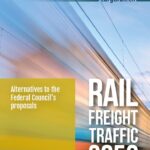
Flyer Rail Freight Traffic 2050
INFORMATIVE
Future rail freight transport in the area / wagonload transport
- Cargo Forum Switzerland response on the «Weiterentwicklung der Rahmenbedingungen für den Schweizer Gütertransport»
- Media release, 15.2.2023: Weiterentwicklung des Güterverkehrs: Varianten des Bundesrates greifen zu kurz
- VAP consultation response on the «Weiterentwicklung der Rahmenbedingungen für den Schweizer Gütertransport»
- LITRA, ASTAG, IG Kombinierter Verkehr, VAP and VöV with the Freight Transport Commission jointly comment on the federal government’s consultation on the «Further development of the framework conditions for Swiss freight transport» (in german)
- Media release, 8.2.2023: Medienmitteilung zur Zukunft des Binnengüterverkehrs
- Interview in RailBusiness, 21.11.2022: Frank Furrer zur Fortführung des Wagenladungsverkehrs
- Media release, 2.11.2022: Unterstützung für einen starken Schienengüterverkehr in der Fläche
- 2.11.2022: Bundesrat gibt zwei Varianten in Vernehmlassung
- Erläuternder Bericht zur Vernehmlassungsvorlage, BAV
- Faktenblatt Digitalisierung
- Faktenblatt Schienengüterverkehr
- Position paper to KVF‑N, 22.6.2022: Future of rail freight transport in the countryside
Energy crisis
- Media release of 21.10.2022: Rail freight must be protected from energy price increases (in german)
- Demand of the European associations
- Regulation 2022/1854
- Freight railways: 28% – in 2023 feared share of electricity in total costs in rail freight transport (in german)
Rail Freight Transport Vision of the Advisory Group on the Development of Rail Freight Transport, 2022
Summary of a study commissioned by the shipping industry
- Study «From integrated to market-oriented railways» in German or in French
Modal shift report 2021
- Federal Council report on modal shift of November 2021 (in german)
- Blog articel: Modal shift: In transit on the right track
Transport of dangerous goods
Legal
Basic studies of the Confederation
- Transport Outlook 2040
- Transport Outlook 2050
- Energy perspectives 2050+
- Transfer report 2021
Underground freight transport
- Legal basis and new investors for “Cargo sous terrain”
- Consultation on the federal law: VAP response
- Consultation on the federal law: Response Cargo Forum Switzerland
- Explanatory report on the consultation draft
- Federal law on the underground transport of goods: consultation draft
Archive
Freight transport in the Covid 19 crisis
- Milderung der pandemiebedingten Auswirkungen auf den Schienengüterverkehr im Jahr 2021
- Finanzielle Unterstützung Schweizer Schienengüterverkehr in der Krise
- Medienmitteilung Unterstützung des Güterverkehrs in der Krise
- Vernehmlassungsantwort zum Bundesgesetz über die Unterstützung des öffentli-chen Verkehrs in der COVID-19-Krise
- Positionspapier Der Güterverkehr zeigt Stärke in der Krise
Relocation report 2019 – industry calls for additional measures
- Bericht des Bundesrats über die Verkehrsverlagerung vom November 2019
- Positionspapier der Branche
- Position der Branche (Präsentation)
- Position der Branche (PDF)
- Medienmitteilung der Branche
- BAV: Botschaft zum Bundesbeschluss über eine Erhöhung und Laufzeitverlängerung des Zahlungsrahmens für die Förderung des alpenquerenden Schienengüterverkehrs
- BAV: Bundesbeschluss über eine Erhöhung und Laufzeitverlängerung des Zahlungsrahmens für die Förderung des alpenquerenden Schienengüterverkehrs
- BAV: Faktenblatt Sinkende Lastwagenzahlen und hoher Marktanteil der Bahn
- BAV: Faktenblatt Verlagerungswirkung der NEAT
- BAV: FAQ Verlagerungsbericht 2019
- BAV: Verkehrsentwicklung im alpenquerenden Güterverkehr infolge Fertigstellung der NEAT
Operations
Freight railway undertakings
 |
 |
 |
 |
| DB Cargo | GATX | Hupac | railCare |
 |
 |
 |
|
| SRT swiss rail traffic | TR Trans Rail | WRS |
|
|
|
| DB Cargo | GATX | Hupac |
|
|
|
| SRT swiss rail traffic | TR Trans Rail | WRS |
|
||
| railCare |
Freight railway wagon rental companies
 |
 |
 |
 |
| VTG | wascosa | ermewa | Groupe Millet |
|
|
|
| VTG | wascosa | ermewa |
|
||
| Groupe Millet |
Shippers (examples)
 |
 |
 |
 |
| Die Post | Holcim | Panlog | Hastag |
|
|
|
| Die Post | Holcim | Panlog |
|
||
| Hastag |
Sites
First and last mile
Over 850 sidings are used in Switzerland. Unfortunately, there is a steady decline. You can find out how the VAP is campaigning for the preservation of the sites and other useful information in the chapter Sites.
Network
The network is about access to the railways, the train paths. Optimal utilisation requires far-sighted construction planning, fair prices and good organisation.
You can find out how we are committed to this and other useful information under the following link.
Power shortage (Part 4): Emergency measures are concretised
Energy security is and remains one of our top issues. The Federal Council is currently concretising the management measures in the event of an electricity shortage in the form of prepared ordinances. Special provisions are envisaged for licensed public transport companies, including rail freight transport. The FOT is preparing a draft ordinance for public transport together with the working group of industry associations, while the VAP represents the interests of freight transport.
This is what it’s all about:
- Federal Council has plan of measures for security of electricity supply drawn up
- Gradual quota system to prevent critical grid shutdowns
- Next step: preparation of specific draft ordinances
- Traction current will become more expensive next year
At its meeting on 23 November 2022, the Federal Council discussed the management measures to be taken in the event of an electricity shortage. For the draft ordinances with graduated
measures until 12 December 2022. The system leader rail commented on behalf of the industry.
Avoiding the worst with each level of measures
With the measures adopted so far, the Federal Council is strengthening the security of electricity supply: maintaining hydropower reserves, providing thermal reserve power plants, increasing the transmission capacity of the electricity grids. In addition, it wants to prepare graduated measures to reduce electricity consumption. Calls for economical electricity consumption and the energy-saving alliance of the business community are intended to raise awareness among companies across the board.
Should a critical power supply bottleneck occur during the winter period, the Federal Council will regulate the power supply with temporary measures. In the event of a crisis, it would issue targeted consumption restrictions with the help of decrees. This is intended to ensure grid stability and thus the supply of electricity. The aim of each stage is to avoid even more drastic measures.
Quota system to prevent grid shutdowns
The Federal Council sees the quota system as a key measure to prevent critical grid shutdowns. In order to ensure its effectiveness, it does not want to exempt any electricity purchasers.
However, it envisages special provisions for licensed public transport companies. Public transport as a core service should be guaranteed for as long as possible. In order to ensure its functioning even in the event of power shortages, measures are to be implemented according to the «public transport management model».
Management measures for public transport
In a working group of VöV, SBB, BAV and VAP, we have worked out the graduated measures for passenger and freight transport in the last few months. In the case of a power quota, freight logistics should basically be maintained and scaled as quickly as possible according to the development of demand. The industry must prepare to react quickly. For it is impossible to predict today in which areas decreases or increases in demand will occur. Based on the “public transport management model”, our working group will develop a corresponding draft ordinance of graduated management measures for public transport. We at the VAP support the approach that has been developed, especially the special measures for public transport.
Traction current will become more expensive
The fact that traction current is not excluded from sudden turbulences is shown by the latest announcement of the SBB. Here, the energy division announces a serious deficit of CHF 180 million for 2022. According to SBB, as a result of the persistent drought in the summer, 90% of the railway’s electricity could not be generated from its own hydroelectric power plants as usual. SBB had to buy expensive electricity on the market at short notice.
After negotiations with the BAV, the SBB will raise the electricity price for 2023 by 3 centimes to 13.5 centimes per kilowatt hour. The BAV wants to pass on the higher electricity costs in the train path price to the various transport sectors on a differentiated basis. In long-distance traffic the full amount of 3 centimes will be passed on, in regional and freight traffic only a part with 1 centime. The fact that SBB’s application for full deficit coverage with a surcharge of 10 centimes was not approved by the FOT may be good news for the railway companies for the time being. But the uncertainty of further surcharges remains, and this will also have an influence on future offer calculations.
Transparency needed
We believe that the provision of electrical energy at a predictable cost rate is central to the future design of offers. The recent price turbulences already seem very adventurous; even more so when one looks back at the many years with a positive balance. We expect a transparent review of the recent events.
The rail sector must reinvent itself
Rail is not exactly famous for its willingness to innovate. This must and will change if it wants to remain sustainable as a transport mode. At the 7th International Railway Forum IRFC 2022, the experts presented a wide range of initiatives, innovations and reorganisations. We have summarised and critically appraised the most important ones here.
This is what it’s all about:
- Implementing the Green Deal requires innovation, new technologies and a comprehensive modernisation of the rail sector
- The scalability of innovations can only be achieved through cooperation and coordination.
- Switzerland must not miss the boat on EU innovation programmes
Under the Czech Presidency of the Council of the EU, the EU Minister of Transport hosted the IRFC in Prague from 5 to 7 October 2022. The motto of the congress was: “Building a new generation of railways together”. The Czech Minister of Transport, Martin Kupka, emphasised the key role of railways for the successful implementation of the Green Deal. With this, the EU has defined a clear answer to the advancing climate change. Traffic and transport in Europe are to become CO2-neutral by 2050. With the 2050 climate targets, the Federal Council is striving to replace fossil fuels in Switzerland within a comparable timeframe.
For a few years now, a paradigm shift has been taking place in the rail sector. Politicians are setting deadlines and issuing concrete mandates to the sectors. In order for the European railways to be able to react according to the mandates, more cooperation is needed in the further development of new technologies and their implementation. The technical pillar of the 4th railway package forms the basis for the creation of the planned unified European railway system.
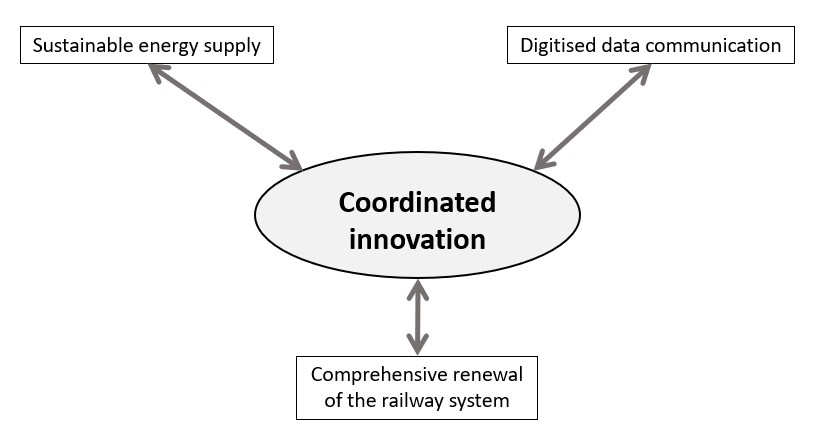
Until new technologies have reached their application maturity, it is first necessary to coordinate innovation (cf. figure) and to conduct targeted research to develop the scientific basis. To this end, the EU has built up efficient and competent organisations in recent years: The “Horizon” programme leads and finances various research projects. Thanks to cross-sectoral networking, the results and findings should be made available to a wide range of users in a timely manner. Within the framework of the innovation partnership Europe’s Rail Joint Undertaking (EU-Rail), innovative new approaches based on research results are given concrete form. The important projects for rail operations and technology are based on the two pillars “System Pillar” and “Technical Pillar”. The Railway Agency ERA defines the new uniform specifications for European railway applications and thus ensures interoperability. Thanks to this pooling of knowledge, solutions ready for international application can be developed in a short time.
Energy of the future is renewable
Until now, industrialised economies have mainly used fossil fuels. For a long time, these were available on the international market at low prices. With the Green Deal, the EU wants to reduce transport-related emissions by 90% by 2050 and shift 75% of the transport volume from road to rail or waterways. The important energy sources of the future are hydrogen and electricity, both produced from renewable resources.
Modern data communication is digital
Industrialised processes function successfully when the necessary data is directly and immediately available to all participants. The current use of data is still limited; for many sub-processes, the data is collected again and again. Such solo efforts are resource- and time-intensive as well as error-prone. In future, data should be available to all authorised participants without media discontinuity and in real time. Direct access to data is central to the realisation of automated processes, as is effective data protection. Cyber security is becoming the core issue of modern data communication.
Reorganisation of the railway system called for
Railways were essential to industrialisation in the 19th and early 20th centuries. It was not until the middle of the 20th century that road and air transport pushed back the railways in transport thanks to their successful innovative steps. The decisive factors were intramodal competition and rigorous customer orientation. The customers’ most important question was: How can we fulfil our needs more easily, more comfortably and more cheaply? And they received suitable answers on the road.
Today, the railways must finally ask themselves the same question. The railway is an efficient and resource-saving transport system with numerous advantages. In a direct comparison of the energy required, the electrified railway is the clear winner over the road. Under the same general conditions, the railway requires 10 times less energy than the road. Important European railway lines are already electrified, so that the required traction energy can be used with high efficiency. Today, a widely ramified network of lines connects the important regions of Europe, a large part of the lines are standard gauge, only in a few European regions are deviating gauges in operation today.
In order for the planned shift of traffic to the railways to actually be realised, a cultural change in the railways towards intramodal competition and customer orientation is first needed, as well as a comprehensive and systematic renewal of the railway system:
- TEN‑T: The EU has defined the trans-European rail network to connect all major European centres. Trains are to be able to run without obstacles on a uniform, harmonised infrastructure; on secondary lines, hydrogen or battery operation can ensure the desired CO2 neutrality. The expansion of the railway network is being carried out with two different emphases: For passenger transport, a high-speed network is to be built that connects the important centres and enables attractive travel times. For freight transport, the necessary train paths are to be made available so that rail freight transport can grow in accordance with the political requirements. The freight railways must more than double their transport capacity in the coming decades. They can only achieve this ambitious goal with the help of innovation. In addition, the corridor managers must be equipped with comprehensive competences so that the current cherry-picking of the national, integratedly managed state railways comes to an end.
- Interoperability and standardisation: The various European railway systems are still subject to a multitude of often different national regulations. Compliance with these still significantly restricts free cross-border rail traffic and enables unfair competitive advantages in the national market. Despite the technical specifications of interoperability (TSI), national regulations still massively hinder cross-border traffic. The EU has made the elimination of these national rules an important leadership task with the “rules cleaning-up programme”. This is a crucial programme of the technical pillar of the 4th EU railway package to create the Single European Railway Area (SERA). While the European Railway Agency (ERA) is responsible for the further development of the Technical Specifications for Interoperability (TSIs), the railway sector has to update and develop the related standards and norms. In the desired ideal case, the TSIs and the standards should sufficiently specify all railway subsystems in all participating European countries. Switzerland also relies consistently on the TSI in the standard gauge sector. It has adopted the first elements of the technical pillar of the 4th EU railway package within the framework of the current overland transport agreement. As the dialogue between the EU and Switzerland is currently at a standstill, the planned continuation is unfortunately not possible at present.
- Digital automatic coupling (DAK): The railways must replace their historically grown but outdated standards such as the classic screw coupling in favour of modern digitalised systems – such as the DAK4 – across the board. This forms a decisive basis for future comprehensive automation in the rail sector. Even more important, however, is the networking of all actors along the entire logistics chain – beyond the mere rail run – thanks to the possibilities of digitalisation. Freely accessible data and booking platforms open up unimagined increases in efficiency and quality. The members of the VAP and SBB are also actively contributing to the success of this important project with their know-how.
- Energy: In the field of energy, the necessary processes for the CO2-neutral production, distribution and simple use of hydrogen are being worked on. For operation on longer, non-electrified railway lines, hydrogen is a promising energy source that can quickly replace fossil fuels.
Marathon with hurdles
With the Green Deal, the EU has defined a comprehensive programme to create a CO2-neutral Europe. However, the member states have different starting points, priorities and interests. Consequently, the implementation of this ambitious programme will have to overcome a number of hurdles. It remains to be seen whether the national interests of the state railways can be sufficiently set aside in favour of a common European solution.
The railway is to play a key role in European passenger and freight transport in the future. It has some convincing advantages. But it must also overcome an aversion to renewal, change and competition that has developed over many decades. The compartmentalisation of markets, especially by the state railways, continues to be a major obstacle in many places. By sticking to national regulations, often under the pretext of safety considerations, state railways want to continue to protect themselves from unwanted international competition. It is up to the member states to help the European idea achieve a breakthrough and to put a stop to unfair practices by their state railways.
The rail sector must set new standards through innovation. It must standardise and streamline its regulatory environment internationally. When developing new systems, large suppliers to the rail sector must not try to gain a one-sided market advantage through exclusive, incompatible products. For sustainable migration success, the sector needs compatible, mature and reliable innovative products. The manufacturers have not exactly distinguished themselves in this respect in recent years.
Whether the intended shift of transport to rail will be feasible on the planned scale depends on the financial resources that can be deployed. There will be no bulging EU coffers for the migration from which the individual companies can help themselves as needed. The individual member states will have to contribute to the renewal and expansion of the railway infrastructure with substantial start-up financing. This also applies to Switzerland. Core projects such as the DAK must be internationally coordinated, otherwise their effect will fizzle out without a sound.
Switzerland is part of Europe
Switzerland, too, can only gain from active participation in these EU programmes. The Swiss standard gauge network with its major transit axes contributes to the trans-European rail network of the EU. It forms an important part of the uniform interoperable European system SERA. Since many of the Swiss transports are cross-border, interoperable solutions are indispensable. Switzerland has fulfilled its planned target with the continuous expansion of the north-south transversals as announced. The Swiss railway network must be further expanded for domestic traffic in order to be able to cope with the growth target in freight transport in the future. Our experts can actively make valuable contributions to development and compete with the best internationally. Our railway companies can strengthen their market position with new concepts, especially in import and export traffic.
The VAP supports joint activities to further develop the rail sector into an important partner in the multimodal transport system. In this context, cooperation at European level and intramodal competition is a crucial prerequisite to achieve the political goals on time. In terms of transport, we are so closely linked with neighbouring countries that our economy needs obstacle-free cross-border traffic and transport services. From an energy point of view, rail is predestined for longer distances. The political differences between Switzerland and the EU continue to hinder the urgently needed international cooperation. The railway industry is well advised to actively seek and cultivate professional exchange despite the hurdles. We can only have a successful railway future together.
Rail freight transport in the territory: the industry develops a joint solution
The freight railways of the umbrella organisation of public transport (VöV) and we at the VAP are holding intensive talks on the upcoming reorganisation and modernisation of rail freight transport in the territory and its sustainable promotion. Here is a summary of the state of the debate and the advantages of an incentive-based funding model.
Those responsible for rail freight at VöV and we at the VAP, as the voice of the shipping industry, want to show together that rail freight transport in the territory can be operated successfully in the long term. The discussions of the industry representatives on the future of inland transport logistics are in full swing and should result in a common position on rail freight transport when the Federal Council sends its message on the “Future orientation of rail freight transport int the territory” for consultation.
Building a sustainable network
The industry players are striving for an efficient network offer (hub and spoke). The operators of rail freight transport and customers in domestic transport should benefit from this in the same way. This requires a new distribution of roles in production and a sustainable financial support model with distinct incentive mechanisms. This must be competition-neutral and at the same time as simple as possible. It must not allow any market and competition distortions between subsidised and non-subsidised freight railways and services or similar disadvantages. The subsidy model should contain few, but implementable incentive mechanisms with maximum effect. Furthermore, it should adapt to developments; the reduction path of the subsidies ideally runs parallel to the AS 2035 and the Zurich bypass line.
Improved framework conditions
In order for the rail freight transport to develop its strengths, better framework conditions are needed – irrespective of the funding model and understanding of its role. These include:
- Reduction of the train path price to European level
- Extension of the reimbursement of the HVF to all road-rail-ship transports
- Extension of investment subsidies to siding owners and operators
- Automation/digitalisation, in particular through digital automatic coupling (DAC)
- Freely accessible data and information platform for more efficient operational handling
Highly effective incentive mechanisms
Industry representatives envisage incentives to shippers and financing and neutralisation of the first and last mile. Incentives to shippers include compensation for new traffic, the reopening of sidings after longer operational interruptions, efficiency improvement measures in shunting operations and for own manoeuvres on the last mile. The operation of the first and last mile is to be financed through compensation to the service provider. The latter offers short-distance services for all freight railway companies at defined (strongly cost-under-recovering) prices.
New role for SBB Cargo
SBB Cargo continues to assume the role of network provider. It handles main runs and shunting, is responsible for planning network traffic and ensures efficient bundling of traffic with individual wagons or wagon groups. To this end, SBB Cargo is in sole contact with the shippers who commission transports in network traffic and in dialogue with the service provider who serves the first/last mile.
In the favour of competition
The representatives of VöV and VAP advocate a sustainable industry solution that offers more planning and investment security and increases the attractiveness of the rail freight market. They envisage a competition-neutral support mechanism that uses existing structures and compensation approaches. The industry’s support model can increase its modal shift effect by offering additional incentives to third parties with a favourable first and last mile. This eliminates the make-or-buy decision for the freight railways. SBB Cargo can operate the network on its own. The solution, which is emerging from the dialogue between freight railways and the loading industry, is intended to strengthen the competitiveness of the players and enable innovation and customer orientation.
It is interesting to note that in 2014, our study had already recommended “non-discriminatory service of the last mile for all railway undertakings”.
- PDF Summary of our study “From integrated to market-oriented rail” (in German, in French)

ELECTRICITY SHORTAGE (PART 3): SHARE SAVINGS APPEALS
The electricity shortage is an urgent political and economic issue. That is why we are keen to ensure that our members are kept up to date. In this third blog episode, we discuss how the railway industry can respond to the Federal Council’s calls for savings by taking voluntary energy-saving measures.
The Confederation has set out the tasks for dealing with a possible energy crisis. Depending on how the energy situation develops, it can take energy-saving measures. Four levels are possible. At present we are on level 1 “voluntary savings appeals”. The Federal Office of Transport performs the central coordination task in transport matters. The Federal Department of the Environment, Transport and Communications (DETEC) has launched the “Energy Saving Alliance” with a broad-based campaign. This alliance calls on organisations throughout Switzerland to support efforts for security of supply in winter and to voluntarily take energy-saving measures. The goal must be to implement measures that are as uniform as possible across the industry in Switzerland. This is best understood by the users of transport services.
VAP joins in
We at the VAP endorse the recommendation to join the “Energy Saving Alliance”. In doing so, we are passing on the wake-up call of the Association of Public Transport (VöV) to our members. At its board meeting on 9 September 2022, VöV published its recommendation paper for the railway industry. In this paper, VöV recommends that the railway industry actively prepare for possible scenarios of an energy shortage and quickly implement the first concrete measures.
To ensure that the energy-saving measures can be implemented in a coordinated manner by all players in the railway industry, the working group “Electricity shortage in public transport” is responsible for their coordination. We are actively involved in this. The working group works closely with the SBB and PostBus AG Switzerland as system leaders. The common goal is to avoid operational restrictions in both passenger and freight transport. Capacities are only to be reduced in the event of a corresponding decline in demand. We are preparing intensively for further escalation levels in various working groups. The public sector should perceive our industry as competent and cooperative.
Because energy is scarce
“Energy is scarce. Let’s not waste it.” Under this campaign title, DETEC has summarised saving tips for private individuals and companies. The railway industry should also save energy voluntarily. This appeal includes implementation measures for numerous buildings used by the railways. They do not restrict the range of rail freight services. Currently, the focus is on lowering the heating temperature and reducing hot water and lighting. In addition, every transport company is required to optimise the energy efficiency of its office and operational buildings. The package will be supplemented by targeted savings measures for employees (train drivers, office staff, workshop staff).
«You won’t go far without courage»
Dr Heiko Fischer presides over the International Union of Wagon Keepers UIP. The former VTG boss talks to the VAP about the future of European rail freight transport and the digital transformation of the rail sector. He would like to see more enthusiasm for the latter and explains why he considers the discontinuation of single wagonload traffic in Switzerland to be fatal.
Dr Fischer, where do you see the biggest challenges and where do you see the levers for the European rail market?
There are quite a few. The railway infrastructure is outdated or in many places a patchwork quilt that has grown historically. There are still borders between the subsystems. Every year that nothing is done, the problem grows, because the infrastructure continues to age unwaveringly. This is where I see the adjusting screw in the coordination of expansion plans, relief routes and corresponding construction measures throughout Central Europe. It is true that the trans-European networks pursue this integrative approach. But secondary lines and fine distribution networks must not be excluded when it comes to investment allocation, expansion and renewal planning, train control systems and regulation.
I see a further control variable in the complete digitalisation of the railway sector, starting with the networking of the infrastructure via the rolling stock to the operational business. There should be a standardised logic with corresponding interfaces. As a result, electrification can take place in a measured and targeted manner. Lightly loaded routes could also be served by hydrogen-powered hybrid locomotives.
«Rail freight relies on public funding for certain urgencies, such as basic digitisation, infrastructure development, electrification, implementation of digital automatic coupling DAC and other time-critical leap innovations.»
Available capital is also a cornerstone. The railway market does not only need sufficient private capital. For certain urgencies, it depends on public funds, for example for basic digitisation, infrastructure expansion, electrification, the implementation of the digital automatic coupler DAC and other time-critical leap innovations. Such investments are beyond the financial powers of the private sector and most state railways. After all, nobody wants to invest in technologies that will only bear fruit in the next decade, perhaps even with other players in the railway system. This brings me to another set screw: we also need an anchored economic understanding of the mechanisms of rail freight transport among governments, regulators and politicians. This requires a rethink on the part of all those involved in the system.
In what way?
The rail sector is not exactly known for thinking proactively and implementing new things quickly. Many see themselves as victims, be it of the past, of wrong decisions, of the road, of the weather or of anything else. In my opinion, that absolutely has to change. After all, we don’t haul goods trains around because we enjoy it, but because we want to generate added value for shippers and our communities. The players in rail freight transport need to put the customer back in the centre of their attention and to be aware of their future needs. For the upcoming change to actually happen, we need more of a start-up mentality, a “can do” attitude.
What innovations have you driven forward at VTG in recent years, and which of them were groundbreaking?
VTG Connect spontaneously comes to mind. This telematics technology collects relevant data on the entire fleet and many transports. It creates the basis for efficient digital fleet management, because it makes data usable for customers, freight railways and maintenance purposes. With this innovation, we have, so to speak, launched the entry into real-time data transmission in freight transport as envisaged by the DAC.
What importance do you attach to the DAC in the future?
The DAC is a catalyst for the digital transformation of the rail sector. With it, a new control logic and real-time data flows can be mapped. We are a long way from that today. The DAC does more than automate the coupling process. It networks train drivers, cargo, cargo carriers and energy, i.e. electricity. The potential of this combined with new digital technologies is immense. The DAC is not only an intelligent train and load control system, but also a facilitator for other digitalisation initiatives such as digital data, train control and booking platforms.
«There will certainly be several platforms, because as before, each company will collect information that it cannot or may not share. One or even more of these platforms will emerge as central hubs that manage the operational railway business.»
What role will these play in the future?
There will certainly be several platforms, because as before, each company will collect information that it cannot or may not share. One or even several of these platforms will emerge as central hubs that manage operational railway operations. As such, they will provide freight operators with reliable information that can be used to reduce the distances between trains, calculate time windows and put more tonnage on the track per unit of time. A pan-European electronic freight traffic control system must not come from a tech giant à la Google, but should develop from within the rail sector itself. In this way, we show innovative strength vis-à-vis other modes of transport.
Perhaps in the future there will even be a superordinate body like Eurocontrol for the central coordination of air traffic control. Such a cockpit could control European rail freight traffic, give the train drivers certain instructions, intervene if necessary and later allow autonomous trains to run. However, such quantum leaps are only possible if digital technologies with artificial intelligence are implemented and take effect. Only they bring dynamism and ensure the necessary speed, which is absolutely central to the success of the digital transformation.
How could rail freight transport in Europe be developed sustainably?
With something that brings the economic impact of freight transport down to a common denominator and to which all players commit. I can imagine that one day there will be a long-term master plan in the sense of a self-regulating yet binding declaration of intent. All participating state and non-state railways would have to co-sign it. This master plan could state that they are working together towards a modal shift. I would remind you of the General Contract of Use (GCU) of 2006, which regulates the interaction between wagon keepers and railway undertakings as wagon operators. The advantage of a supranational agreement without the character of law is that it can be supplemented or adapted quickly and easily. The accesses to the NRLA are the best example of what should not happen: The community of railway states, including Switzerland, has committed itself to expanding the north-south axis. When Switzerland opened the NRLA tunnel, other states had not even started planning. A master plan for European freight transport could make this intention more binding and make it clear that the Green Deal and modal shift goals are meant seriously. Today it is still a pipe dream. Most of the time, everyone agrees with the basic demands. But as soon as it comes to working out something concrete from a single source, opinions diverge.
What do you think of the Federal Council’s report on ‘Rail Freight Transport in the Area’? What would it mean if the Federal Council abolished it?
In my opinion, that would be the biggest mistake in transport policy for decades. Switzerland proves that wagonload traffic works. However, it is still too expensive. But if train formation and separation are automatic, the train line is digitally controlled and the market benefits from the many advantages of digital offers, then the costs will also go down – and the need for subsidies will decrease. The Federal Council should think about how to make the offers more attractive for freight rail customers. To call the whole thing off even before digitalisation bears fruit would be criminal. Transferring rail freight to trucks also costs money and not every freight can be containerised for block trains. In my opinion, the Swiss government should be more confident in this area. Those who lack courage have already lost.
We at the VAP are members of the UIP. How would you describe the VAP?
It is a valuable member association of our European wagon keeper family. I perceive it as innovative and opinionated. Because of its unique membership structure, it has a special weight with us. The VAP represents not only the five largest Swiss wagon keepers, but also the interests of shippers, sidings and representatives of multimodal logistics chains. This diversity generates impact and a wealth of ideas among us, and I consider it a valuable strength. With its member diversity, the VAP can focus its demands more holistically on the users and place them with greater authority. I support the VAP’s client-centred approach, which involves the end-user in the discussion and decision-making process. Europe can benefit from the Swiss experience with wagonload traffic or the performance-based heavy vehicle charge. It is often seen as a “minilab” that mirrors issues for us. Furthermore, the VAP shows us in an exemplary way how to convince the population or how to shape something positively as a community.
What can the VAP do better?
Better is always possible. My appeal is not only to the VAP, but to all associations and people involved in transport policy. We need committed people who are willing to formulate interests with a view to the future. There are enough of those who think in terms of quarterly balance sheets. But that is no way to win the future.
What do you wish for this future?
More interest, more confidence. More enthusiasm. Shippers should be eager to put even more tonnes on the rails. This is the only way we can achieve the ambitious modal shift and climate targets. The population should realise how important rail freight transport is – and that it costs money. After all, an unchecked flood of lorries is not an alternative. I hope that you from the VAP and we from the UIP will continue to stand up for this departure day after day.
Dr Fischer, thank you very much for the informative interview.
|
Dr. Heiko Fischer Dr. Heiko Fischer served VTG for a total of more than 25 years until 2021, including more than 17 years as Chairman of the Executive Board. Since 2015, he has been President of the umbrella organization International Union of Wagon Keepers UIP, based in Brussels, as he was from 2004 to 2007. This represents more than 250 freight wagon keepers and maintenance centres with more than 223,000 freight wagons, which cover 50% of the tonne-kilometres in European rail freight transport. Dr Heiko Fischer’s former employer VTG AG operates the largest private freight car fleet in Europe with around 88,500 rail freight cars. In addition to hiring out freight wagons and tank containers, VTG offers multimodal logistics services and integrated digital solutions. |
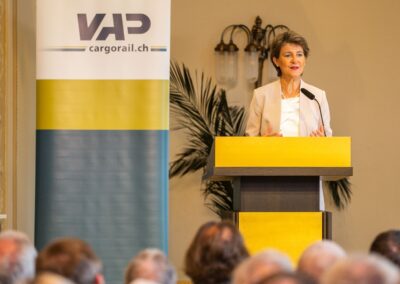
VAP General Assembly of 19 August 2022
Our General Assembly made it clear: 2050 is fast approaching. On site and virtually, numerous VAP members and guests followed the statutory part with a memorable opening speech by President Josef Dittli. A special highlight was the speech by Federal Councillor Simonetta Sommaruga on the importance of rail freight transport for Switzerland.
General assembly, association, freight transport – after these words most people are mentally gone. Today, reading on is recommended. Because on the occasion of our general assembly, it was not only about statutory matters of the shipping industry. In her guest speech, Federal Councillor Simonetta Sommaruga gave a noteworthy signal to the logistics industry: «For the Federal Council it is clear: we want to further strengthen the potential that rail has for freight transport.»
Memorable things about then, today and the day after tomorrow
The opening speech by VAP President Josef Dittli gave the participants valuable food for thought about everything that was, is and should be in rail freight transport. He said that rail freight had played a major role in ensuring that Switzerland survived Corona without any damage in terms of supply, because routes with little passenger traffic suddenly allowed it to operate as it should be able to in normal times. Dittli described the digital automatic coupler as the epitome of digital transformation in rail freight transport, because it stands for the kind of innovative further development that we urgently need. For example, so that all freight railways can establish cooperative and flexible network transport across the board together and without disadvantage. The President looks to Europe with concern. In his opinion, Switzerland must not miss the connection to the European railway sector and the EU innovation programmes under any circumstances.- Download the presidential address by Josef Dittli (in german)
- Watch the video of the presidential address
Landmark decision imminent
We were very pleased that the Minister of Transport, Simonetta Sommaruga, agreed to give a guest speech at our General Assembly. In her speech, she emphasised that the Confederation wants to further strengthen the railways and pay more attention to domestic transport, which is also of great importance for the supply of Switzerland. “We must improve and further develop the system,” said the head of DETEC. She said that the Federal Council would send a bill on this subject for consultation in the autumn. “We are facing a groundbreaking decision. That is why we should not lose sight of what is the recipe for Switzerland’s success, what has always made our country strong: That we tackle the necessary changes best together, that we take responsibility together: Railways, industry and, of course, the Confederation.” The VAP is happy to respond to her invitation to involve ourselves in the discourse, not least with its contribution to the discussion “Rail Freight Traffic 2050″ and the film “Customer-oriented, Innovative, Profitable – Rail Freight Transport of the Future”.- Download guest speech by Federal Councillor Simonetta Sommaruga
- Watch the video of the guest speech
Elections successfully held
Of the items on the agenda that were put to the vote in the statutory part, all were accepted. We welcome the following new members to the Board: Titus Bütler, Bernhard Hoffmann, Bernhard Kunz. We congratulate all of them on their election or re-election and look forward to a constructive cooperation in the Board.
Power shortage (part 2): Prepare now for later
Should an electricity shortage actually occur in Switzerland due to the geopolitical crisis and supply bottlenecks, it is essential that freight transport customers can continue to be served. This means that the transport companies must clarify their energy needs in the event of a shortage and answer some key questions today.
The Swiss railways play a decisive role in coping with the high demand for both passenger and freight transport. They depend on a secure supply of electrical energy.
Ensuring supply via rail
If at some point the available traction current is no longer sufficient for all scheduled trains, journeys would have to be cancelled accordingly. The question is: which ones? We at the VAP are firmly committed to ensuring that our members can continue to serve all freight transport customers. The population and the economy depend on reliable transport chains. That is why freight trains must continue to run as long as possible even in a power shortage situation – as they did, by the way, in the thinned-out timetable during Covid-19.
Political leadership needed
The Swiss railway system is almost exclusively electrically powered. Most of the required traction current (16.7 Hz) comes from the country’s own hydroelectric power plants. Shifting transports from rail to road when there is a shortage of traction current is not very promising. In the event of a serious bottleneck, fossil fuels would also become scarcer. In order to maintain functioning transport chains, the companies involved in rail transport also need industrial electricity (50 Hz). Here, too, security of supply must be ensured. Security and reliability are required: The transport sector and the freight railways must be able to rely on the political leadership in the event of a crisis. Because even then, goods trains have to roll as long as there is demand. We want to strengthen this awareness among decision-makers.
Energy shortage not excluded
Let’s not fool ourselves: An unfavourable coincidence of really negative developments could manoeuvre Switzerland into a serious energy shortage situation as early as next winter. As representatives of the electricity and gas industries explained at the Economiesuisse webinar on 9 August 2022, energy supply is highly complex and dependent on many influences.
The Confederation assumes responsibility
The Confederation is aware of its responsibility. It takes measures to secure the energy supply and prepares for critical scenarios of an acute power shortage. Depending on the situation, these measures range from voluntary, industry-specific
industry-specific savings appeals to prescribed management measures (quota system).
Determine demand and savings potential
If you think about your own energy needs now, you will be prepared for an actual electricity shortage and less likely to be surprised. So it is time to assess your energy needs, reserves, alternatives and savings potential. This assessment helps to decide how, in the event of an electricity shortage, to reduce consumption in line with higher-level targets and still contribute to the supply of essential goods. Concrete questions in the company are, for example:
- Which activities require how much energy, what is their importance in production?
- What is the most effective energy-saving potential?
- How large are the reserves, how much energy can be dispensed with and for how long?
- Where can we switch to other energy sources and how quickly?
- Is communication in the production chains good? Are the contacts up to date?
- What restrictions do we implement to meet a quota?
Cooperation and communication
Companies should be open about these considerations. After all, it is not possible to predict which scenarios will actually occur at which point in time. The players in the sector can maintain the supply of important goods as well as possible if they cooperate across companies and communicate actively. That is why we at the VAP, as representatives of the shippers, are already actively involved in various committees and working groups.
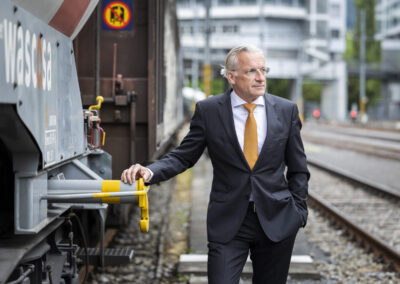
«We want to be faster and better than the others in the future as well.»
In June 2022, the takeover of the family business WASCOSA by Swiss Life and Vauban was announced. We wanted to know more about the background to this sale and the vision of WASCOSA from the former owner and future Chairman of the Board of Directors Philipp Müller.
Mr Müller, the news of the sale of your successful family business came as a surprise. What will change?
Philipp Müller: Less than you might think at first glance. With this step we have secured the future of WASCOSA. Of course there will be a change from a family-run to an investment-driven company. But the spirit of WASCOSA will remain. We want to continue to act faster and better than others, to be successful as a team and to put customers’ interests before our own. These goals are demanding, but doable.
What prompted you to take this step?
The succession plan and securing the future of the company. Neither of our children was interested in succeeding me. So we had to find an external solution to this question. Eight years ago, we had already hired a CEO from outside the family, Peter Balzer. In addition, our market is currently undergoing an enormous shakeout. Of the ten largest car rental companies in Europe, we are the only ones who have not experienced a merger or takeover. Those who are still in the game are constantly getting bigger, making major long-term investments and taking high financial risks. We simply needed more financial strength for WASCOSA to be able to survive as an SME in this market. We found these strong financial partners in Swiss Life and Vauban.
What other solutions were on the table?
At first we considered a minority shareholding by third-party shareholders. However, this did not result in an optimal solution for the parties involved. Selling to a competitor was never on the table. In the end, long-term cooperation with a strong financial partner proved to be the most sustainable.
«WASCOSA has established itself from a small, unknown rental company to a successful supplier of freight car systems throughout Europe through innovation, customer proximity and agility.»
What experiences from the past will shape the future of the company?
WASCOSA has established itself from a small, unknown rental company to a successful provider of freight car systems throughout Europe through innovation, customer proximity and agility. We want to maintain this latter position. One example of our innovative strength: there is currently a strong trend towards modular freight car concepts. We introduced such concepts 15 years ago. Now that the trend is catching on, we are ready for the market. In the last 60 years of our company, an uncompromising customer orientation has made the difference in our daily business. We want to keep it that way too. It is in the interest of the new owners that WASCOSA remains at its core what it has always been: an innovative and customer-oriented company.
How will you master this change process?
The participation of Swiss Life and Vauban as third-party shareholders was derived from an intensive strategy process with around 15 employees. After the decision was made, we introduced the new shareholders to the company at a one-day event. Throughout the entire strategy process, we wanted to avoid uncertainty, mistrust and false assumptions on the part of management and employees. We succeeded in doing so, and we are doing everything we can to ensure that we also succeed under the new ownership. CEO Peter Balzer and I will still be on the Board of Directors. This is a strong message with regard to continuity and the future of WASCOSA.
«The DAC is a key project with enormous potential to move freight wagon transport forward.»
Where do you see the most urgent need for action in rail freight transport?
There are different starting points. We need sufficient capacities on the network, i.e. more train paths. In addition, country-specific obstacles should be removed. And finally, rail freight transport is dependent on targeted financial support to get innovations rolling, for example the digital automatic coupling (DAC).
Speaking of DAC: what do you think about it?
It is a key project with enormous potential to move freight wagon transport forward. However, we have little influence on this highly political topic. We have been working on the electrification of freight wagons for several years. Here, of course, the DAC gives us an additional boost.
Is the real added value of the DAC recognised by the industry?
Our industry is not too keen on innovation and also not very future-oriented. The automation of coupling by the DAC has arrived. I am not so sure about its potential for digitalisation. As always, it probably first needs someone to lead the way and make the efficiency gains clear.
You have been involved in the VAP’s Executive Committee (GLA) for years. How do you describe the work of the VAP?
The VAP is characterised by a high level of competence and a pleasant working relationship. The association’s activities are driven by the cause and not by the ego of individuals. The VAP is the leader in some areas. This is shown by the high level of participation at home and abroad in events such as the forums. This interest proves that the VAP takes up political, economic or legal issues proactively and constructively. I found the get-together at the GLA very positive. In the dialogue with SBB, the association shows staying power. Here, passenger transport comes first, then infrastructure, then real estate and only then rail freight. That makes it all the more important to keep at it. The patience and constant cooperation of Frank Furrer’s team stand out.
What strengths do you attribute to the VAP?
One of its main strengths is the large number of shippers among its members. The VAP networks all the players in freight transport. In addition, it offers the shippers’ industry a highly interesting and relevant platform. I think that you can only make successful policy if you represent all interests.
How has the VAP supported you and your WASCOSA?
We have had very good experiences with the VAP. It has even supported us competently and successfully all the way to the Federal Court.
What else would you like to see from the VAP?
That it becomes more visible in the media. The VAP could appear more prominently as an opinion-leading expert on rail transport and thus increase its public profile, just like the TCS or ASTAG.
To whom would you recommend cooperation with the VAP?
Everyone who is interested in rail freight transport. I am thinking above all of associations from other modes of transport. For a long time now it has no longer been just about rail versus road, but about sensible multimodal co-existence.
What has not yet come up in this conversation?
The topic of sustainability. Rail freight transport is one of the most important drivers and carriers of sustainable transport. Incidentally, this was also one of the reasons why I took over from my father-in-law at WASCOSA 30 years ago.
Mr Müller, thank you very much for the interesting interview.
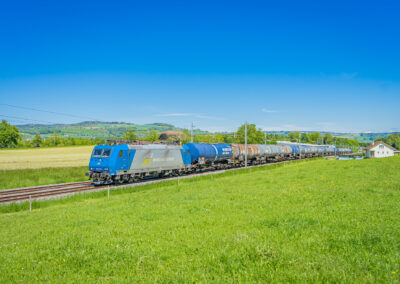
Economic advantages of a competitive freight railway
Freight transport plays a crucial role for the national economy as it enables the exchange of goods and services. In view of the challenges such as limited road capacity and climate change, the shift of freight transport to rail is becoming increasingly important. Here we explain the economic benefits of a modal shift.
Limited road capacity:
The road infrastructure is limited and is already reaching its limits in many regions. Due to the increased use of HGVs in freight transport, traffic on the roads continues to rise, leading to congestion, delays and increased transport costs. Shifting freight traffic to the railways relieves the roads. This enables more efficient use of existing infrastructure and reduces the need for expensive road extensions.
Climate change and environmental pollution:
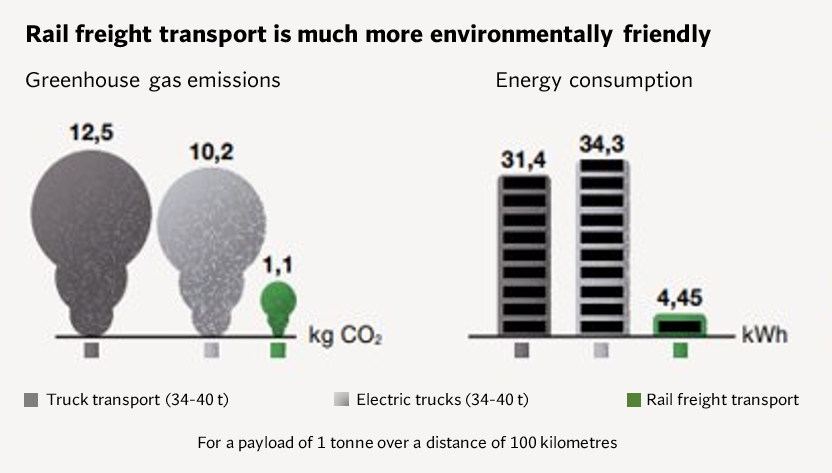
The transport sector contributes significantly to CO2 emissions and other harmful environmental impacts. Compared to road transport, rail transport is more environmentally friendly, as trains produce on average fewer emissions per tonne-kilometre. In addition, rail transport reduces noise levels and minimises air pollution in urban areas, resulting in an improved quality of life for the population.
Efficiency and economy:
Rail offers high efficiency in freight transport as trains can carry larger loads than trucks. By using goods trains, large quantities of goods can be transported in one go, which leads to an optimisation of transport costs. This allows companies to improve their logistics processes and increase the efficiency of their supply chains. A more efficient freight transport connection leads to lower transport costs, which in turn increases the competitiveness of companies and has a positive impact on the national economy. Through digitalisation, the necessary freight wagons can be efficiently networked, thus avoiding fixed costs.
Safety and accident prevention:
Shifting freight transport to rail contributes to increasing road safety. Compared to road transport, accidents in rail transport are less frequent and generally have a lower impact on life, health and the environment. Reducing HGV traffic on the roads minimises potential sources of danger and increases safety for other road users.
Experienced logistics experts needed
Independent and sector-specific logistics experts are needed who specialise in specific products. The railways should concentrate on operating the trains, while the overall logistics are in the specialised hands of the logistics experts.