
FREIGHT TRANSPORT INDUSTRY
What moves the freight transport industry? Various factors have an impact on the freight transport industry. As the voice of the shipping industry, we are campaigning for a competitive rail freight system. To this end, we monitor, among other things, modal shift and lobby politicians for non-discriminatory rail.
The future of inland freight transport
Further development of freight transport: variants of the Federal Council do not go far enough
COMPETITION IN RAIL FREIGHT TRANSPORT
Interoperability
The optimisation of processes and interfaces and the connection with the 4th EU railway package.
Sustainability
The motion by Josef Dittli, member of the Council of States, calls for an overall concept on how rail freight transport and multimodal logistics solutions can contribute to reducing CO2 emissions.
Digitalisation
What is helping European rail freight to reach the next dimension of modernisation?
Flyer Rail Freight Traffic 2050
INFORMATIVE
Future rail freight transport in the area / wagonload transport
- Cargo Forum Switzerland response on the «Weiterentwicklung der Rahmenbedingungen für den Schweizer Gütertransport»
- Media release, 15.2.2023: Weiterentwicklung des Güterverkehrs: Varianten des Bundesrates greifen zu kurz
- VAP consultation response on the «Weiterentwicklung der Rahmenbedingungen für den Schweizer Gütertransport»
- LITRA, ASTAG, IG Kombinierter Verkehr, VAP and VöV with the Freight Transport Commission jointly comment on the federal government’s consultation on the «Further development of the framework conditions for Swiss freight transport» (in german)
- Media release, 8.2.2023: Medienmitteilung zur Zukunft des Binnengüterverkehrs
- Interview in RailBusiness, 21.11.2022: Frank Furrer zur Fortführung des Wagenladungsverkehrs
- Media release, 2.11.2022: Unterstützung für einen starken Schienengüterverkehr in der Fläche
- 2.11.2022: Bundesrat gibt zwei Varianten in Vernehmlassung
- Erläuternder Bericht zur Vernehmlassungsvorlage, BAV
- Faktenblatt Digitalisierung
- Faktenblatt Schienengüterverkehr
- Position paper to KVF‑N, 22.6.2022: Future of rail freight transport in the countryside
Energy crisis
- Media release of 21.10.2022: Rail freight must be protected from energy price increases (in german)
- Demand of the European associations
- Regulation 2022/1854
- Freight railways: 28% – in 2023 feared share of electricity in total costs in rail freight transport (in german)
Rail Freight Transport Vision of the Advisory Group on the Development of Rail Freight Transport, 2022
Summary of a study commissioned by the shipping industry
- Study «From integrated to market-oriented railways» in German or in French
Modal shift report 2021
- Federal Council report on modal shift of November 2021 (in german)
- Blog articel: Modal shift: In transit on the right track
Transport of dangerous goods
Legal
Basic studies of the Confederation
- Transport Outlook 2040
- Transport Outlook 2050
- Energy perspectives 2050+
- Transfer report 2021
Underground freight transport
- Legal basis and new investors for “Cargo sous terrain”
- Consultation on the federal law: VAP response
- Consultation on the federal law: Response Cargo Forum Switzerland
- Explanatory report on the consultation draft
- Federal law on the underground transport of goods: consultation draft
Archive
Freight transport in the Covid 19 crisis
- Milderung der pandemiebedingten Auswirkungen auf den Schienengüterverkehr im Jahr 2021
- Finanzielle Unterstützung Schweizer Schienengüterverkehr in der Krise
- Medienmitteilung Unterstützung des Güterverkehrs in der Krise
- Vernehmlassungsantwort zum Bundesgesetz über die Unterstützung des öffentli-chen Verkehrs in der COVID-19-Krise
- Positionspapier Der Güterverkehr zeigt Stärke in der Krise
Relocation report 2019 – industry calls for additional measures
- Bericht des Bundesrats über die Verkehrsverlagerung vom November 2019
- Positionspapier der Branche
- Position der Branche (Präsentation)
- Position der Branche (PDF)
- Medienmitteilung der Branche
- BAV: Botschaft zum Bundesbeschluss über eine Erhöhung und Laufzeitverlängerung des Zahlungsrahmens für die Förderung des alpenquerenden Schienengüterverkehrs
- BAV: Bundesbeschluss über eine Erhöhung und Laufzeitverlängerung des Zahlungsrahmens für die Förderung des alpenquerenden Schienengüterverkehrs
- BAV: Faktenblatt Sinkende Lastwagenzahlen und hoher Marktanteil der Bahn
- BAV: Faktenblatt Verlagerungswirkung der NEAT
- BAV: FAQ Verlagerungsbericht 2019
- BAV: Verkehrsentwicklung im alpenquerenden Güterverkehr infolge Fertigstellung der NEAT
Operations
Freight railway undertakings
 |
 |
 |
 |
| DB Cargo | GATX | Hupac | railCare |
 |
 |
 |
|
| SRT swiss rail traffic | TR Trans Rail | WRS |
|
|
|
| DB Cargo | GATX | Hupac |
|
|
|
| SRT swiss rail traffic | TR Trans Rail | WRS |
|
||
| railCare |
Freight railway wagon rental companies
 |
 |
 |
 |
| VTG | wascosa | ermewa | Groupe Millet |
|
|
|
| VTG | wascosa | ermewa |
|
||
| Groupe Millet |
Shippers (examples)
 |
 |
 |
 |
| Die Post | Holcim | Panlog | Hastag |
|
|
|
| Die Post | Holcim | Panlog |
|
||
| Hastag |
Sites
First and last mile
Over 850 sidings are used in Switzerland. Unfortunately, there is a steady decline. You can find out how the VAP is campaigning for the preservation of the sites and other useful information in the chapter Sites.
Network
The network is about access to the railways, the train paths. Optimal utilisation requires far-sighted construction planning, fair prices and good organisation.
You can find out how we are committed to this and other useful information under the following link.

Notable facts from the autumn session 2021
Dispatch 20.081 on the Federal Law on the Underground Transportation of Goods
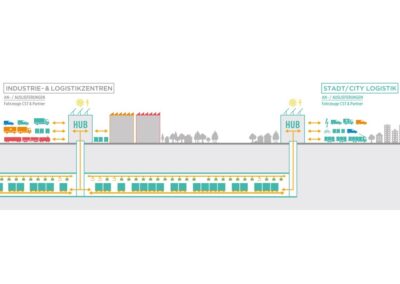
With the adoption of the federal bill, the legal basis for the Cargo Sous Terrain (CST) logistics project has been created. A final difference over expropriation must be settled in the coming winter session. From 2031, the first CST goods are to be transported through the underground tunnel. However, this will hardly relieve freight traffic above ground, as freight transport is continuously increasing. We therefore continue to adhere to our goals of making rail freight transport more efficient for the future. Our commitment to the «automation of rail freight transport» is an important starting signal for this.
Postulate 21.3597 «The Future of Freight Transport»
By accepting the postulate, the Federal Council undertakes to submit a report on the future direction of rail freight transport policy by the end of the first quarter of 2022. In doing so, it must examine aspects of domestic and import/export traffic in depth and answer these questions, among others:
- How should the impact and achievement of objectives of a market-oriented and self-supported offer by SBB Cargo AG be assessed with regard to organisational structure, modal shift effects, transport performance, infrastructures, service points, needs of the loading industry and staffing levels, climate-friendly and resource-saving orientation of the supply chains?
- What are the effects and prospects of the strategic realignment of SBB Cargo AG?
- What are the political scenarios for the further development of rail freight and, if applicable, the need for legislative action?
- What framework conditions for the use of rail infrastructure (track access charges) and the financing of the necessary investments are necessary so that the service can be operated in a way that covers the area and costs as far as possible?
- What investments in new rolling stock, automation and digitalisation are necessary and how can these be financed?
Thinking in terms of opportunities
We at the VAP see a great need for action in the legal framework, the infrastructure and the logistics platforms. The market should focus on evaluating opportunities and chances. We focus on multimodal transport concepts that make use of the strengths of the respective transport modes. Wagonload transport is part of this multimodality. As a classic network transport, it requires new cooperation between all actors in order to increase efficiency and effectiveness. For this purpose, we have founded the IG Wagenladungsverkehr together with other stakeholders.
Compromise for UGüTG: Discrimination ban yes, disclosure of calculation no
After the Council of States decided to delete the prohibition of discrimination in transport services offered in Art. 5 UGüTG, the National Council decided to retain the article while waiving the disclosure of the calculation of the non-discriminatory price. This compromise allows RailCom to identify any discrimination in the design of offers and prices. The Council of States ultimately endorsed the National Council’s decision.

VAP becomes a member of SWISS SUPPLY
VAP as new competence partner
With the SWISS SUPPLY association, the most important logistics, supply and transport organisations in Switzerland want to promote the image of logistics, supply chain and transport and carry out public education work. The VAP, as the representative of the shipper industry in rail freight transport, joined the support organisation in August 2021 to contribute to these objectives. In this way, we create the best conditions for our members for an economically fruitful environment and a broad public understanding for a well-functioning supply. In future, we will coordinate our transport policy activities in Cargo Forum Switzerland with the initiatives of Swiss Supply in order to develop even more clout together.
How it came about
The idea for SWISS SUPPLY came about at the beginning of 2020 as part of the new focus exhibition “Experience Logistics!” at the Swiss Museum of Transport. The intention was to realise such image projects and corresponding initiatives in the future under the umbrella of a national non-profit organisation and with combined forces in a sustainable manner. Thus, the Swiss Association for Vocational Training in Logistics (ASFL SVBL), the Swiss Commercial Vehicle Association ASTAG, the value creation network GS1 Switzerland, the professional association for purchasing and supply management procure.ch, the association of Swiss forwarding and logistics companies SPEDLOGSWISS, the logistics network VNL Switzerland and the Swiss Logistics Foundation founded the new association SWISS SUPPLY on 26 March 2021. The organisation will be chaired by Jörg Mathis, CEO of GS1 Switzerland. The members of the organisation also form the sponsoring body and represent well over 10,000 members.
Strengthening supply, logistics and transport in Switzerland
Many people do not know: The national supply with the areas of procurement, logistics, storage, transport, forwarding, packaging, disposal and recycling form a system-relevant backbone of the Swiss economy. The initiators of SWISS SUPPLY want to improve the reputation of these sectors in Switzerland in the long term and arouse interest and understanding for them among the public. To this end, existing initiatives are being intensified and new activities launched. In addition, the association wants to generate enthusiasm for the industry among young people at an early stage. SWISS SUPPLY shows students and career changers comprehensive career opportunities with development possibilities in various directions.

Motion CO2-free rail freight transport
The motion 20.3222 «Rail freight transport and contribution to reducing CO2 emissions» submitted by VAP President and Councillor of States Josef Dittli was adopted by both Councils. The aim is to draw up a plan of measures that outlines how rail freight transport and multimodal logistics solutions can make a better contribution to reducing CO2 emissions. In the action plan, technical, operational, infrastructural, legal and financial options are to be identified, evaluated and put together into a promising package of measures. The cantons, railways, logistics service providers and shippers are to be involved in the work of the federal administration.
Harnessing the sustainability of rail freight
With the Green Deal, the European Union aims to become climate-neutral by 2050. On 28 August 2019, the Federal Council aligned Swiss greenhouse gas targets with this. As a consequence, the transport sector must reduce CO2 emissions by 90%. Freight rail is an essential part of the solution towards CO2 neutrality. For example, SBB Cargo uses hybrid locomotives on the last mile. Trains use 90% hydropower for their propulsion, and from 2025 it will be 100% renewable energy. Rail freight should therefore take up a higher share of transports. In transport logistics, there is a trend towards smaller consignment sizes, shorter transit times and higher punctuality requirements. Only a multimodal logistics chain with the freight railway as a strong link can do justice to this package of tasks. Here, logistics service providers bundle the goods or packages for the railway and synchronise them with the timetable. Promoting multimodal logistics solutions in all combination forms of rail, road, Rhine favours energy-efficient and CO2-optimised transport solutions and relieves the environment in social, ecological as well as economic terms. The federal government should support this multimodality with suitable measures.
Not a new concern
SR Dittli had already submitted a similar interpellation in March 2019 (19.3148 «CO2-free rail freight transport and Energy Strategy 2050»), which suggested a reduction in the train path price in connection with the train path price revision as of January 2021 to promote sustainable rail freight transport. In December 2019, several motions with identical wording followed in parliament calling for a support package for public transport based on its sustainability. This new motion is now intended to trigger a strategy definition geared towards passenger and freight transport in order to prevent a further expansion of passenger transport at the expense of freight transport capacities on the network. Above all, however, the remaining legal, operational and technical hurdles in the road/rail interface that hinder multimodal logistics solutions are to be removed as far as possible.
UGüTG: Prohibition of discrimination and the disclosure of prices
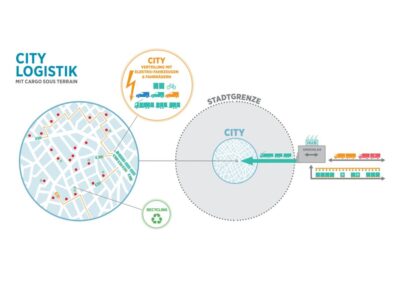
The draft of the UGüTG provides for a ban on discrimination for all transport services offered, in particular also for services offered above ground in city logistics. During its deliberations, the Council of States criticised this ban on discrimination and the disclosure of prices.
The VAP welcomes the ban on discrimination and the disclosure of prices. The linking of underground main transport with above-ground distribution from a single source obviously entails the risk of discrimination.
Our experience with SBB Cargo’s wagonload traffic, the service of the last mile to private sidings and terminals as well as access to private terminals is clear: a monopoly offer from a single source is fatal for the loading industry. A specific prohibition of discrimination must therefore be provided as a regulatory measure in addition to the generally applicable Cartel Act. Competition with other transport systems such as rail or road does exist. But just as rail freight transport is the only mode of transport that can offer the night jump, the combined offer of city logistics and main run of Cargo sous terrain enjoys a unique USP. This is also the reason why the Confederation has an economic interest in this infrastructure and decided to enact the UGüTG.
Access to other private infrastructures is also specifically regulated by law in a non-discriminatory manner. Access to terminals is regulated in Art. 6 para. 1 lit. d Freight Transport Ordinance, GüTV: Conditions, prices and discounts must be non-discriminatory and disclosed on the internet. For the service of sidings and terminals (last mile), transparency has unfortunately been reduced: Art. 6a GüTV only requires the general description of the “assessment of the price”. Art. 5 para. 3 lit. c of the UGüTG is also formulated in this sense: “Calculation of the price”. This is the minimum variant to protect customers against the monopoly provider.
The price should be in line with the market. This is also the case for terminal access and last mile service. But it must not be discriminatory, for example by providing a discount for particularly close “friends” that cannot be justified from an economic point of view. The principles developed in connection with network access to the rail network have proven their worth and should also apply to city logistics and underground mainline services.
For these reasons, the VAP recommends that Parliament adopt Art. 5 UGüTG unchanged.
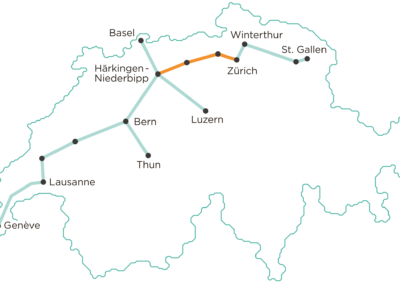
Draft Federal Law on the Underground Transport of Goods
The VAP welcomes the framework law on underground freight transport presented by the Federal Council. We see an underground transport system as a positive addition to the existing possibilities on water, road and rail. The bill offers a liberal, risk-oriented and autonomous framework for the construction and operation of the facilities, so that efficient and thus economical multimodal transport can succeed. Clarifications are still necessary, particularly in the coordination of procedures at federal and cantonal level. The FOT should be given a clear coordination role for this.
The involvement of state and state-related companies raises questions, as does the intention to design city logistics as a one-stop service by the operators of the underground transport system. The VAP prefers a competition-oriented city logistics in order to exclude market power and discrimination.