
The VAP promotes freight transport by rail.
The VAP Association of Shippers campaigns for market-oriented framework conditions and an attractive Swiss rail freight system. Relevant topics:
Freight industry
- How do we shape the future of freight transport?
- What moves the freight industry?
- An overview of the players in rail freight transport.
Network
Here you will find useful information on railroads, their organization and network access.
Financing
Information on financial support and charges in freight transport.
Sites
Everything about free loading, terminals, sidings or even multimodal logistics hubs.
Interoperability
The VAP is committed to harmonizing the framework conditions so that trains can run effortlessly on European rail networks.
Sustainability
For a far-sighted future, various areas need to be designed sustainably.
Innovation
How can we drive innovation in freight transport?
Operations
In favor of fair competition, we want to utilize the strength of all modes of transport and combine them optimally. Because this makes the route shorter – and more economical – for everyone.
Events
Here you will find further information and documents on our events Forum Freight Transport, our General Assembly and others.

Revision of the noise limits
That’s what it’s all about:
- Silence is a precious commodity in densely populated and industrialised areas
- Federal government has issued regulations on noise abatement
- FOEN mandated to review existing regulations
The Confederation has issued regulations on noise abatement that lay down framework conditions for industry and transport in particular. The Federal Office for the Environment (FOEN) was mandated by Parliament to review the existing regulations. In the current year, the FOEN is conducting a comprehensive economic assessment (VOBU) of nine possible measures, analysing their noise-reducing effect and economic consequences in connection with traffic noise. The regulations for the construction and licensing of vehicles and aircraft are to continue to be coordinated internationally. The FOEN aims to present the findings transparently to important representatives from industry and the cantons and to discuss implications with them.
The Association of the Freight Industry (VAP) will be actively involved and contribute the industry’s perspective. The FOEN will complete the VOBU by the end of 2023 and the Federal Department of the Environment, Transport, Energy and Communications (DETEC) will decide on the further procedure and publish this at the beginning of 2024. We will report on new findings here.
The following focal points are considered:
- Adjustment of the limit values for road, rail and air traffic noise
- Adjustment of the assessment period (rest period)
- Standardisation of the sensitivity levels
- Simplification of the noise classification regime (restriction of the protection of existing buildings)
- Dynamisation of noise protection (temporary relief)
- Clarification of measures (definition of test criteria)
- Strengthening transparency (disclosure of relief)
- Strengthening of the polluter-pays principle (compensation for advance payments)
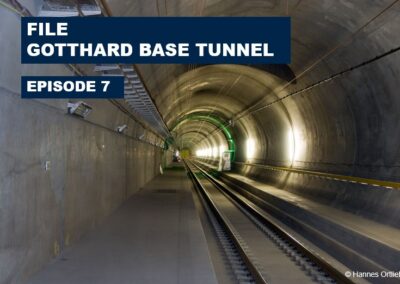
Gotthard Base Tunnel (#7): Sust report provides clarity
On 28 September 2023, the Swiss Safety Investigation Authority (Sust) published its interim report on the derailment of the freight train in the Gotthard Base Tunnel. It documents the course of the accident and makes initial safety recommendations. The event is now being processed by the responsible international committees. Both the European railway industry and Switzerland are represented here. The report should not be misused for a national solo action.
This is what it’s all about:
- Fatigue cracks caused wheel breakage
- Further investigation is well coordinated
- Consequential initial safety recommendations
- Accident clarified – but not yet completely solved
Fatigue cracks caused wheel breakage
Fortunately, Sust submitted its interim report very quickly. In it, it identifies the broken wheel disc of the eleventh freight wagon as the cause of the derailment in the Gotthard Base Tunnel. The wagon is registered in Sweden. The damaged wheel is wheel type BA 390 with LL brake pads. All the fractured surfaces show fatigue cracks originating from the tread. They are now the subject of in-depth metallographic examinations by Sust. The Sust report contains no evidence of pre-existing operational defects that could have caused derailment.
Further investigation is well coordinated
The incident is now being dealt with by the Joint Network Secretariat (JNS). The aim of this body is an EU-wide harmonisation of all measures taken after an accident or incident in European rail transport. The JNS supports the European Railway Agency (ERA) in organising the exchange of experience between national supervisory and investigative authorities and the industry organisations accredited by ERA. The latter also include the three players in the triangle of responsibility for rail transport: the infrastructure manager (responsible for the infrastructure), the wagon keeper (responsible for the maintenance of the wagons) and the freight railway undertaking (responsible for the operation of the wagons). At the same time, Sust triggers a so-called Safety Alert in the SIS information system, which is used by the national supervisory and investigative authorities. And finally, the Swedish wagon keeper deposits a warning message in ERA’s Safety Alert IT Tool (SAIT).
Based on these notifications and as part of the coordinated process, all European stakeholders should have access to the published information. It is now up to them to draw the right conclusions in the exchange between national authorities, industry representatives and ERA. Thanks to the Land Transport Agreement, Sust is recognised by ERA as an investigative body, as is the Federal Office of Transport (FOT) as a safety authority. The matter is now being dealt with by the competent international bodies. We consider this fact to be entirely correct and necessary in view of the cross-border use of freight wagons throughout Europe. The responsible bodies will next establish a reference to similar wheel breakages from the past.
Consequent first safety recommendations
The Sust report makes two short-term safety recommendations, which the VAP supports without reservation. In Recommendation No. 183, it advocates that the FOT extend the 2017 “JNS Urgent Procedure Broken Wheels” to the BA 390 series wheelsets. The “JNS Task Force Broken Wheels” set up at that time had reacted to several wheel fractures on the BA 314 and BA 004 wheel types and called for more intensive inspections in operation and maintenance to limit the risks for these wheel types. We also welcome Safety Recommendation No. 184, in which Sust urges the FOT to apply for a new “JNS Procedure” at European level to deal with the wheel breakage on the BA 390 series. This should prevent further similar wheel breakages from occurring.
Accident clarified – but not yet completely solved
The interim report corrects the misleading media coverage of the accident, according to which the derailed wagon 11 also damaged the safety gate to the east tunnel, which weighed about 100 tonnes. According to Sust, it was not until carriage 14 hit the switch track at the Faido multifunction station switch that it struck the safety gate. Further investigations are necessary to fully clarify the accident in detail. This includes, for example, analyses of the wagon 14 and the switch. Sust will only provide a complete clarification of the course of events and causes of the accident in its final report. Once this has been published, it is the responsibility of all actors involved in the JNS procedures to draw the right conclusions from it for competitive and safe European rail transport. The recommendations of the Sust final report will be implemented by the entire industry.

Marco Rosso: «Collaborative innovation can contribute to the quality of life and function profitably at the same time.»
Marco Rosso is Chairman of the Board of Directors of Cargo sous terrain AG (CST). In an interview with the VAP, he talks about interoperability, non-discrimination on the last mile and the logistics of the future. And about how collaborative innovation can contribute to the quality of life of people in Switzerland and function profitably at the same time.
VAP: Mr Rosso, how do you see the relationship between rail freight and CST in the future?
Marco Rosso: Rail and CST are two systems that complement each other. CST cooperates with all modes of transport to jointly absorb the predicted freight traffic growth of over 30% by 2050 in an innovative, sustainable way. Because CST is not suitable for all transports, the company supports the business models of rail, road hauliers and other logistics players with new technology and digitalisation. Only with cooperation (within the framework of competition rules) can interoperability be guaranteed among the most diverse modes of transport and transport companies. Therefore, CST plans to connect to rail, road, ship, air freight and other systems. At the CST hubs, there will be multimodal connections, in particular also a rail connection. In the construction phase, starting as early as 2026 and continuing until 2045, CST will use rail transport to the tune of 2,000 goods trains per year and thus become an important rail customer.
Shouldn’t the state create the infrastructure and the operation in the tunnels, as well as the operation of the terminals and the last/first mile would then be free and subject to competition?
CST is a system that only works as a whole because all processes are controlled end-to-end. This is the only way to ensure that the general cargo reaches its destination on time and reliably. For this reason, the system must be managed from a single source and at the same time be connectable to all partner platforms. CST has been planned and conceived as a private-sector project from the very beginning. With this financing concept, it is possible and important to move forward quickly without straining the funds in the federal budget. The investors also include important future customers. They help to develop the system in line with the market. The Confederation has recognised that it would not be expedient to act as a creator itself, but to limit itself to the legal framework. With carefully prepared business plans, competitive prices and the broad investor base that supports the project, CST shows that innovation in freight transport contributes to the quality of life in cities and rural areas and can function profitably at the same time.
Where do you see the biggest challenges in your project?
Such a comprehensive project presents many challenges, for example in planning, legal, environmental, financial and political terms. What distinguishes CST is the model of collaborative innovation – with the inclusion of all stakeholders. The project approaches the challenges pragmatically in stages.
How do you design a non-discriminatory first/last mile?
Our system is planned to be non-discriminatory from the start anyway, without the law requiring it. The following applies throughout: everyone has access to the system with the same price for the same service. But we go even further, for example, by developing CST’s city logistics in a collaborative partnership and are open to any cooperation with smaller as well as larger partners, including the railways and the post office. Here, too, our principle is collaborative innovation, which we live by every day.
What is the greatest benefit or motivation of CST for the Swiss population?
The most important effect of CST will be to increase the quality of life for all inhabitants of Switzerland. By showing a way how the logistics of the future can look sustainable, how heavy traffic on the road can be moved away by bundling and pre-sorting in tunnels for all shippers, or how a traffic jam can be avoided for the supply of goods, how to get the best out of the available resources in terms of CO2 emissions, noise, etc. The precious space on the surface should primarily belong to the population. CST favours the expansion of infrastructure as well as renewable energies in Switzerland. CST is a privately financed driver of innovation for the benefit of the Swiss economy and for quality of life in cities and villages by guaranteeing security of supply and thus increasing prosperity in Switzerland.
Are there any points that you think we should still let our members know about?
There are decisive decisions and discussions ahead, especially against the background of the political debates on freight transport. We are firmly convinced that with an entrepreneurial attitude we can make an effective contribution to maintaining Switzerland in the 21st century as an excellent business location with a high quality of life, also for future generations. We participate in this work with enthusiasm and commitment.
Mr Rosso, thank you very much for the interview.
Strengthen fair competition between federal and private companies
On 15 September 2023, the Federal Council instructed the Federal Department of Economic Affairs, Education and Research (EAER) to submit an amendment to the Corporate Governance Guidelines by the third quarter of 2024. In doing so, it wants to strengthen fair competition between state-owned enterprises and private-sector companies.
This is what it’s all about:
- Owner’s strategy and corporate governance guidelines as a steering instrument
- Parliament has called for fair competition
- Worrying monopolisation of local delivery services
- Further cross-financing tendencies evident
- A fight with unequal stakes
Ownership strategy and corporate governance guidelines as a management tool
Federal companies are created through the independence of administrative units of the Confederation which, according to the Federal Constitution, carry out monopolised activities. For example, the special-law joint-stock company of the Swiss Federal Railways (SBB) was created in the course of the railway reform in 1999. As the wholly-owned owner, the Confederation steers its numerous federal companies by defining and implementing an owner’s strategy and corporate governance guidelines. It also elects the members of the Board of Directors. In addition to its role as owner, the federal government also has other roles: as a regulator, it regulates the market conditions and occasionally even orders public services, for example in regional passenger transport. This inevitably results in certain conflicts of interest. It would be appropriate to examine whether this interweaving of functions is still in keeping with the times and appropriate for single wagonload traffic, and which supervisory body is keeping an eye on how this is handled.
Parliament has demanded fair competition
The private sector’s increasing criticism of the behaviour of federal companies, which, on the basis of a constitutional mandate that is often kept very general, continue to expand their original core business and even buy up private companies, was heard in parliament. Thus, the Councils adopted motion 20.3531 “Fairer competition vis-à-vis state-owned enterprises” by FDP Councillor of States Andrea Caroni and the identically worded motion 20.3532 by Die-Mitte Councillor of States Beat Rieder. With the EAER report, the Federal Council now wants to meet the demand of these two motions. It expects proposals on how the departments can more systematically organise and more comprehensively ensure fair competition between federal and private companies in the management of federal enterprises.
Worrying monopolisation of local delivery services
RailCom’s Activity Report 2022 reports, among other things, on the survey of freight railways on short-distance delivery services in accordance with Art. 6a of the Freight Transport Ordinance (GüTV). These are services provided by SBB Cargo, which covers local delivery in Switzerland on a virtually monopolistic basis. The RailCom activity report lists a lack of resources as the reason for rejecting local delivery services. However, the respondents suspect that they are disadvantaged in the offers and that different tariffs are in circulation.
Private companies are equally concerned about the monopolisation of SBB Cargo’s network offer in the consultation on the draft law “Modernisation of Swiss freight transport” (see blog post “Consultation on rail freight transport in the area: Two variants, many question marks”). They demand a strict demarcation between network services and block train services in terms of remuneration and continued non-discriminatory access to services in local delivery (cf. VAP blog post “Outsourcing the last mile and making it non-discriminatory”). With the help of organisational measures or a legal separation, it must be prevented that certain services provided by the state are cross-financed. This is the case today, for example, with the funding of the SBB pension fund (PK SBB) through the profits of SBB Immobilien.
Further cross-financing tendencies evident
During the consultation on the 2025 train path price revision, Switzerland’s freight railways joined forces and gave the Federal Council a negative response to the partial revision of the Ordinance on Network Access (NZV) on 29 August 2023 (see blog post “Train path price revision 2025–2028: Price increase is unfounded”). Only SBB Cargo, which is fully integrated into the SBB Group and kept on a short leash, was left out. Since the Federal Office of Transport refers, among other things, to falling train path revenues in the train path price revision, the impression is created that this is a case of hidden cross-financing by SBB, which of course SBB Cargo is not allowed to criticise.
The bill drafted by the Federal Council “Amendment of the Federal Act on Swiss Federal Railways SBBG – sustainable financing of SBB” of 15 September 2023 also corresponds to a blatant interference in free competition. According to this, SBB is to benefit from a capital subsidy of CHF 1.25 billion. The exact use of these funds remains unclear and there is a lack of conditions that could change this in the future. Subsidiary SBB Cargo, which also received extensive financial support in the aftermath of the Covid pandemic, also benefits from this capital injection. It is about to conclude a performance agreement for the compensation of its network traffic, which it obviously cannot handle on its own. The private sector players, on the other hand, did not receive Covid funds, nor do they have substantial non-operational resources and stakes that they could sell off to strengthen their investment capacity.
A fight with unequal stakes
The Federal Council’s self-evidently unequal treatment of state-owned and private-sector companies is conspicuous – and regrettable. Unfortunately, this does not create healthy competition in rail freight transport, which strengthens its innovative power and efficiency. Both are essential if the market players want to retain existing customers and win new ones. This in turn would be necessary to achieve a sustainable modal shift and to integrate rail into multimodal supply chains in the future. And to create new, future-oriented jobs.

REVISION OF THE RAILWAY ACT: FULL EFFECT MAY NOT MATERIALISE
On 12 September 2023, the National Council approved the revision of the Railways Act (EBG), following its unanimous approval by the Council of States in the 2023 summer session. However, the revision of the Railways Act cannot be fully implemented until the 4th EU railway package is included in the land transport agreement or the transitional solution with the EU is extended. Inefficiencies could therefore remain.
That’s the point:
- What has happened so far
- Switzerland has adopted three EU railway packages
- Revised EBG creates equivalent conditions
- Ordinances must also be adapted
- Inclusion of the 4th EU railway package in the Land Transport Agreement necessary
What has happened so far
The 4th EU railway package has been in force since 16 June 2019 and the EU Railway Agency (ERA) is now responsible for issuing uniform safety certificates and approvals for rolling stock for cross-border traffic. In the 2023 summer session, the Council of States approved its committee’s request to amend the Railways Act (implementation of the technical pillar of the 4th EU railway package).
The 4th EU railway package contains three key elements:
- The applicable regulations are to be systematically harmonised in all participating countries. This is achieved through institutionalised entry into force procedures for the technical specifications for interoperability, TSIs and their updates. This means that TSIs published by the EU Commission are now directly valid in all countries; national implementation processes are no longer required.
- ERA monitors the removal of obsolete national regulations by the responsible national supervisory authorities.
- ERA now coordinates the authorisation procedures and issues uniform, cross-border operating licences.
ERA operates the online vehicle authorisation portal “One Stop Shop”. It works closely with the national supervisory authorities when checking authorisation dossiers. Today, an application for authorisation can be made and the corresponding dossier submitted in ERA’s “One Stop Shop”. The ERA examines the dossier in consultation with the national supervisory authorities involved and issues an operating licence that is directly valid in all the countries applied for.
Switzerland has adopted three EU railway packages
Switzerland has adopted the relevant technical provisions of the three EU railway packages as part of the land transport agreement with the EU. It already sits as an observer on the relevant committees for the ongoing development of interoperability and co-operates with the ERA. It has not yet been possible to join the ERA.
Revised EBG creates equivalent conditions
The technical pillar of the 4th EU railway package includes the revision of the requirements for interoperability (Directive 2016/797) and railway safety (Directive 2016/798). It also includes the further development of the ERA into an EU supervisory authority with the One Stop Shop for standardised procedures (see blog article “Switzerland faces isolation in international rail transport”). The revision of the Railways Act lays the foundations for implementing the technical pillar of the 4th railway package. Accordingly, all interoperable Swiss railways are to be subject to the same conditions as EU member states and access to the simplified authorisation procedure is to be opened up via ERA.
Ordinances also need to be amended
On the basis of the amendments to the EBG, the FOT can establish the necessary conformity with the EU directives in a second step at ordinance level. It has therefore already prepared the corresponding draft amendments to the ordinances and had them reviewed by the EU Commission – with a favourable result. Switzerland has thus independently created the basis for the equivalence of its legislation with that of the EU.
Inclusion of the 4th EU railway package in the land transport agreement necessary
With the implemented revision of the EBG, Switzerland has gained valuable time. After all, it usually takes several years for a revision of the law to come into force. In this case, the national legal framework is already in place. However, the inclusion of the technical pillar of the 4th EU railway package in the Land Transport Agreement and accession to the ERA are necessary for it to take full effect. Neither is foreseeable for the time being in the context of the faltering negotiations between the EU and Switzerland. The EU requires an agreement on the framework agreement and the opening of passenger transport in Switzerland (part of the 3rd EU railway package). The latter has so far failed to materialise; all attempts by the FOT to make concessions by softening the market partitioning by Switzerland have so far been unsuccessful.
Full interoperability and a fundamental simplification of authorisation procedures reduce administrative and operational costs. This is fundamental for safe and competitive rail (freight) transport and thus for a successful modal shift.
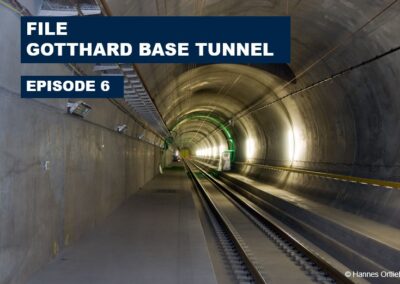
Gotthard Base Tunnel (#6): FOT pragmatically supports freight traffic
After the freight train accident in the Gotthard Base Tunnel, the Federal Office of Transport (FOT) is promoting rail freight transport with tangible measures: The tunnel may only be used for freight trains. The compensation per train operated in unaccompanied combined transport (UCT) will soon be increased to up to CHF 1,100. We, as the association of the shipping industry, would like to express our sincere appreciation for this. By the way: our voice also applies to foreign shippers.
This is what it’s all about:
- Gotthard base tunnel only open for rail freight traffic
- Higher compensation for transalpine UCT
- The VAP says thank you
Gotthard Base Tunnel open for freight trains only
Since the reopening of the east tunnel of the Gotthard base tunnel, it has been available exclusively for freight traffic. Around 100 train paths are possible every day. A further 30 trains per day run through the mountain section. This means that transalpine rail freight traffic has a total of 130 train paths at its disposal every day. By comparison: in 2022, an average of 120 trains crossed the base tunnel every day.
Thanks to this measure, the freight railways can handle rail freight traffic practically without restrictions. Admittedly, the routing over the mountain route is associated with considerable additional expense. But it mainly affects domestic traffic that is not dependent on the 4‑metre corridor.
Higher compensation for transalpine UCT
The FOT is committed to transalpine rail freight traffic and in particular transit traffic (see “The FOT strengthens rail freight traffic through the Alps”). The compensation per train operated in UCT will be increased by CHF 200 to up to CHF 1,100 in the coming weeks. The FOT also does not want to reduce the compensation per consignment for 2024, but will introduce a symbolic reduction of CHF 1 to CHF 57 per consignment. In this way, the FOT is supporting transalpine UCT in a very pragmatic way. Against the background of the difficult construction site situation on the access routes and the tense economic situation, the FOT is refraining from continuing on the current course to reduce compensation for UCT.
The VAP says thank you
The FOT deserves a big thank you for this pragmatic support. It strengthens the joint and targeted efforts of the entire industry to make the capacity restrictions on both the Gotthard and Lötschberg axes as bearable as possible. We see it as a sign of a common policy effort to support modal shift in transit traffic.
Train path price revision 2025–2028: Price increase is unfounded
The Federal Council plans to increase the train path price in freight transport from 2025. In detail, it wants to raise the basic price for wear and tear by almost 20%; on the grounds of uncovered weight-dependent marginal costs in this area. We reject this unjustified price increase. It accelerates the ongoing modal shift to the roads and contradicts the Federal Council’s modal shift objective.
This is the issue:
- Track access charges not derived transparently
- Traffic losses prohibit price increases
- Respect the legal principle of cost recovery and the polluter pays principle
- Incentive for low-wear freight wagons reversed
- Make infrastructure managers more accountable
Track access charges not derived transparently
The explanatory report of the Federal Office of Transport (FOT) of June 2023 is neither transparently designed nor comprehensibly justified. The reasons for the current determination of the train path price remain completely unclear. Since the FOT refers, among other things, to falling train path revenues, the impression is created that this is a hidden cross-financing of the SBB. Against the background of the “Sustainable Financing of SBB” bill and the reduction of the contribution margin in SBB passenger traffic envisaged therein, this justification is unreasonable for the representatives of freight traffic. Our negative response to the above-mentioned bill can be found in our hearing response of 7 March 2023 and in our blog post “SBB should take responsibility instead of 3 billion financial package”.
Traffic losses prohibit price increases
A price increase is unacceptable in view of the traffic losses in domestic, import, export and transit traffic and the significantly cheaper train path prices in the European environment. Shippers have been exposed to drastic price increases for years, especially in wagonload traffic. These are justified by exogenous factors such as train path prices.
Respect the legal principle of cost recovery and the polluter pays principle
The FOT justifies the price increase with the legal principle of cost recovery. This would be upheld even in the event of a price reduction in freight transport. On the contrary, a price reduction is in line with the polluter-pays principle, since freight traffic pays the standard marginal costs of an averagely developed network, which is mainly geared to the needs of passenger traffic. Shippers do not notice the efforts made by the infrastructure managers to build and maintain the infrastructure more cheaply.
Incentive for low-wear freight wagons twisted
The so-called wear factor is supposed to serve as an incentive to use low-wear rolling stock. In the meantime, the opposite is the case: the Federal Council is encouraging the industry not only to pay ever higher track access charges, but also to invest additional financial resources in low-wear rolling stock.
Holding infrastructure managers more accountable
The presented train-path price revision goes easy on the infrastructure operators. As representatives of the siding and terminal operators, who are directly affected by the planning, construction and maintenance costs of SBB Infrastructure in centralised sidings, we observe considerable inefficiencies and an almost shameless handling of financial resources. This is most likely equally true for the public network. The federal government should therefore also oblige infrastructure managers to contain costs.
Gotthard Base Tunnel (#5): Too early to assign blame and liability
According to the main edition of the SRF Tagesschau news programme from 27 August 2023, the Federal Office of Transport (BAV) views SBB Cargo as solely liable for the consequences of the freight train accident in the Gotthard Base Tunnel. The programme made reference to an oversight of the rail reform; prior to this, all freight wagons had to be sent to the Federal Railways for maintenance. We believe: It is too early for speculations, and certainly not in media with a nationwide audience. Such polemic does not help solve the problem in any way whatsoever. Only the report of the Swiss Transportation Safety Investigation Board (Sust) will establish clear facts – and create opportunities to respond appropriately.
Topics discussed:
- The state retains the upper hand in the rail market
- The rail reform did, in fact, reform liability law
- Wagon keepers are liable independent of fault
- Federal Council did not propose any legal changes
- Contractual provisions are public
- Responsibility must be assigned based on the Sust report
- Current liability rules are economically balanced
- Negative consequences of legal changes must be considered
The state retains the upper hand in the rail market
The federal government clearly assigns responsibility for the freight train accident in the Gotthard Base Tunnel to the SBB subsidiary SBB Cargo. A spokesperson for the BAV indicated on SRF Tagesschau on 27 August 2023 that the applicable liability law originates from the time of the Federal Railways. However, the times have not changed. The Swiss Federal Railways, SBB, still dominate the rail freight market. Only a few weeks ago, the Federal Council approved the renationalization of SBB Cargo. In response to the interpellation by FDP National Council Member Christian Wasserfallen, the Federal Council made clear that the private shareholders had not improved the (financial) situation of SBB Cargo.
The rail reform did, in fact, reform liability law
In the course of the rail reform, the international Convention Concerning International Carriage by Rail (COTIF) was amended to create a separation between infrastructure and operations. At the same time, SBB Cargo terminated the siding contracts. The monopoly privilege, which required that freight trains be sent to the Federal Railways for maintenance, was hereby abolished. Instead, the conditions for use of the freight wagons were standardised between the freight railway undertakings and the wagon keepers at the international level on the basis of COTIF in the form of a contract entitled the “General Contract of Use for Wagons (GCU)”. COTIF and the GCU set out more stringent liability rules than are preferred by the BAV with its reservations against internationally uniform industry solutions. Wagon keepers were in for an unpleasant surprise as they took over full responsibility for the future maintenance of their wagons: The SBB provided the wagon keepers with extremely sparse documentation on the condition and maintenance of their freight wagons by SBB Cargo up to the termination of the siding contracts. Since then, the wagon keepers have themselves been responsible for their wagons and have cleaned up the legacy from SBB.
Wagon keepers are liable for deficiencies on their wagons
With his comments on SRF Tagesschau, the BAV spokesperson gave the impression that private freight railway undertakings or wagon keepers are not liable for accident damage. This is not true. European and Swiss freight railway undertakings and wagon keepers have been liable since 2006, when the GCU was established, and these rules were further intensified in 2017. Today, freight railway undertakings are fundamentally liable for damages from accidents involving freight trains on the Swiss rail network regardless of their own culpability (strict liability). If the damages were caused by deficiencies on a third-party wagon, culpability is contractually assumed to lie with the respective wagon keeper. The freight railway undertaking involved can take recourse against the wagon keeper. The latter can only free itself from liability with respect to the freight railway undertaking by proving it was not at fault (reversal of the burden of proof). You can read more about this in our blog post “Gotthard Base Tunnel (#3): Current liability provisions are sufficient”.
Federal Council did not propose any legal changes
SRF news editor Christoph Leisibach stated that the Federal Council issued a report proposing measures for adapting the liability law, such as by increasing the liability of the wagon keepers. This statement is incorrect. In the BAV report from 21 June 2023 addressing postulate 20.4259 “Overall assessment of liability in rail freight transport”, the Federal Council presented options but explicitly declined a modification of the regulations.
Contractual provisions are public
Professor Frédéric Krauskopf was consulted by SRF Tagesschau as an expert. When asked whether SBB Cargo could assert (co-)liability on the part of the wagon keeper of the damaged wagon, Krauskopf referred to the contract between the two parties. As explained above, the relevant contract is the GCU. This contract is publicly available; in other words, it is also accessible to professors and public television networks. The GCU was adopted unanimously by SBB Cargo along with all other national railways in Europe.
Responsibility must be assigned based on the Sust report
We at VAP are intensively examining the question of who bears what fault for the freight train accident on 10 August 2023 and who must accept liability. This can only be answered precisely and within a reasonable timeframe after the Sust report is available.
Current liability rules are economically balanced
The wagon keepers must ensure that their wagons are approved and maintained according to the correspondingly applicable laws, regulations and binding standards. The freight railway undertakings accept the wagons in the trust that the wagon keeper has lived up to these obligations. They carry out all necessary inspections to ensure that the train can travel safely. The wagon keepers have no influence on the train departure. The freight railway undertakings independently decide on the type and manner of the inspections since they are also solely responsible for the operation of the train. It therefore makes economic sense for the freight railway undertakings to be primarily liable for their inspections prior to train departure and for possible consequences. If it is later determined that a deficiency on a wagon was the cause of the damage (such as in the case of wheel failure), the wagon keeper is liable to the freight railway undertaking for the resulting damages. This is the case unless the wagon keeper can prove that it is not responsible for the deficiency (reversal of the burden of proof). In road transport, the liability between the keeper of the tractor vehicle and the keeper of the trailer is regulated in exactly the same way.
Negative consequences of legal changes must be considered
An intensification of the already highly detailed liability provisions will not make rail freight any safer nor will it bring a single additional freight train onto the rail network. On the contrary. Whatever might be changed in the liability rules would have market consequences, such as in the form of higher leasing rates for freight wagons and, above all, more complicated and labour-intensive wagon handoffs from one area of responsibility to the next. This means that a poorly conceived, unilateral change in Swiss law could bring a sudden stop to the free access to 550,000 freight wagons from all over Europe that is guaranteed today by the GCU – to the detriment of the environment as well as the Swiss economy.
Gotthard Base Tunnel (#4): Safety-critical components of freight wagons
The publicly published information on the freight train derailment in the Gotthard Base Tunnel indicates a broken wheel on the derailed train. Overloading or material defects are under consideration as possible causes of the failure. What actually happened remains a matter for the ongoing investigations of the Swiss Transportation Safety Investigation Board (Sust).
Topics discussed:
- How are safety-critical components manufactured?
- How are they approved and put into operation?
- How are they maintained?
- What significance does monitoring have in daily operations?
- Which monitoring possibilities exist?
- Uniform rules enable safe cooperation between the actors
- Outlook for digital automatic coupling (DAC)
How are safety-critical components manufactured?
Safety-relevant and safety-critical components such as wheel pans are designed so as to perform their task over the planned period of use under the prevailing conditions of operation and use and thereby to ensure safe travel. The manufacturing firms make use of internationally recognised standards to accomplish this:
- Technical Specifications for Interoperability (TSI) establish fundamental requirements.
- European Standards (EN) define the specific properties.
- Manufacturers employ harmonised and standardised safety methods for development and testing.
- Standardised safety verifications and assessments document the safety and usability.
The international experiences from incidents and accidents continuously enter into the development of the standards and TSI.
How are they approved and put into operation?
Bringing safety-critical components onto the market requires an internationally standardised approval from the European Agency for Railways (ERA) or a national safety authority. This consists of:
- Type approvals for components or vehicles
- Conformity verifications for identical serial parts or vehicles
- CE mark (Conformité Européenne) for a component that satisfies the applicable EU directives
- Operating authorisation for a vehicle in compliance with the rules
The certification that components were manufactured according to the requirements of standards and TSI is issued by so-called “notified bodies”, in other words state-authorised agencies. These inspect and evaluate whether the manufactured products conform to the rules.
How are they maintained?
The manufacturer is obliged to define and publish the applicable maintenance requirements for all components or vehicles. Wagon keepers must implement these manufacturer requirements in accordance with the conditions of use. They appoint certified entities in charge of maintenance (ECMs) for their rolling stock. The latter in turn establish maintenance requirements for the vehicles assigned to them in consideration of their own knowledge and industry expertise. They also plan regular work, carry it out and document the results. Every wagon approved for operation must be registered in an official vehicle registry, including the name of the wagon keeper and the ECM.
What significance does monitoring have in daily operations?
The railway undertakings (RUs) are responsible for the safe travel, preparation, dispatching and other safety aspects of their trains. They define the inspections and tests for ensuring that every trip can be completed safely. To determine this operational suitability, trained employees carry out defined visual inspections before departure. This extremely demanding work takes place at all times of day and in all weather. During the train dispatching and the associated inspections and tests, safety-critical components are also afforded special attention.
Which monitoring possibilities exist?
The wagon keepers are responsible for the proper maintenance of their vehicles. Safety-relevant and safety-critical components are regularly inspected, such as with ultrasound measurements. Safety-critical components are subject not only to strict inspections but also special obligations with regard to labelling, maintenance and traceability of the measures. The RUs can demand wagon-specific information from the wagon keepers.
On the Swiss standard gauge network, the infrastructure operators currently maintain over 250 wayside train monitoring systems. These monitor every vehicle as it passes by for irregularities and can trigger alarms in the event of unacceptable deviations. In this case, the respective train is immediately stopped and inspected.
Uniform rules enable safe cooperation between the actors
A variety of different companies all work together in railway operations. Every actor must be able to depend on the reliability of the others at the points where they interface together. Their tasks and responsibilities are clearly and uniformly regulated at the international level. Harmonised regulations for manufacture, operation and maintenance ensure safe rail transport (for more on the regulations governing the international cooperation, check back on this blog again soon).
Outlook for digital automatic coupling (DAC)
Besides implementation of the applicable requirements by every actor participating in rail transport, new technologies are now coming to the fore. Automation and digitalisation can do more than simply make operating processes more efficient. They also open up new opportunities for operational monitoring of safety-relevant and safety-critical components in freight trains. The ongoing digital recording of the condition of these components offers an attractive opportunity to the responsible parties. By digitally tracking processes of wear and ageing processes on each individual vehicle, it is possible to efficiently plan maintenance work according to the actual needs. Faulty components can be identified and replaced before a total failure. If a component failure occurs during travel, this can immediately trigger an alarm.
To make use of this innovation in freight transport, the wagons require sensor systems, electrical energy and data communication with the train driver, the systems of the wagon keepers and the ECMs. These prerequisites will be met with the planned Europe-wide introduction of DAC (see the blog post “Data ecosystems: Sharing data to double its added value”). In this way, automation and digitalisation are transforming conventional rail freight operations into an intelligent, efficient, resilient and safe mode of transport.