
The VAP promotes freight transport by rail.
The VAP Association of Shippers campaigns for market-oriented framework conditions and an attractive Swiss rail freight system. Relevant topics:
Freight industry
- How do we shape the future of freight transport?
- What moves the freight industry?
- An overview of the players in rail freight transport.
Network
Here you will find useful information on railroads, their organization and network access.
Financing
Information on financial support and charges in freight transport.
Sites
Everything about free loading, terminals, sidings or even multimodal logistics hubs.
Interoperability
The VAP is committed to harmonizing the framework conditions so that trains can run effortlessly on European rail networks.
Sustainability
For a far-sighted future, various areas need to be designed sustainably.
Innovation
How can we drive innovation in freight transport?
Operations
In favor of fair competition, we want to utilize the strength of all modes of transport and combine them optimally. Because this makes the route shorter – and more economical – for everyone.
Events
Here you will find further information and documents on our events Forum Freight Transport, our General Assembly and others.
Gotthard Base Tunnel (#3): Current liability provisions are sufficient
The freight train accident in the Gotthard Base Tunnel has brought up liability questions that were already on the agenda of the Federal Council. In its session on 21 June 2023, the Federal Council issued a report on possible actions to intensify the liability provisions in rail freight transport. Read on to learn what these look like and what we think of them.
Topics discussed:
- Railway undertakings (RUs) are liable independent of culpability
- The Federal Council proposes four possible actions – with pros and cons
- We believe: Responsibilities and controls are sufficiently regulated
- Actors will live up to their responsibilities even without new provisions
Railway undertakings (RUs) are liable independent of culpability
The status quo is that RUs are fundamentally liable for damages from accidents involving freight trains on the Swiss rail network regardless of their own culpability. This is referred to as strict liability. However, this does not apply if the damage was caused due to deficiencies in a third-party wagon. In that case, culpability is contractually assumed to lie with the respective wagon keeper. The keeper can only free itself of this liability by proving it was not at fault. In legal jargon, this is termed a reversal of the burden of proof.
The Federal Council proposes four possible actions – with pros and cons
In its report from 21 June 2023, the Federal Council was complying with postulate 20.4259 “Overall assessment of liability in rail freight transport”. This was established by means of motion 20.3084 «Clarifying liability rules in rail freight transport” from Frédéric Borloz (see VAP blog post “Motion Borloz”). Within the framework of the overall assessment, the Federal Council presented four possible actions to the Parliament:
- Expanding the strict liability of the RUs to also include cases in which the characteristic risk of rail operations was not a causal factor. This would raise the minimum insurance coverage of the RUs.
- Oblige the RUs to conclude sufficient liability insurance to also cover damages from the transport of hazardous goods. This would not expand the strict liability of either the RUs or the wagon keepers.
- Introduce fault-independent liability on the part of the wagon keepers for damages that were verifiably caused – in whole or in part – by their vehicles or their cargo, e.g. in the event of leaked hazardous goods from a parked wagon. This would oblige the wagon keepers to conclude sufficient liability insurance for such cases.
- Keep the current regulations.
The Federal Council notes that each option features pros and cons. The Council sees no urgent need for regulation in this regard. Nevertheless, it is willing to look more deeply into specific variants at the request of the Parliament.
We believe: Responsibilities and controls are sufficiently regulated
As a shipping sector association, we are of the view that the responsibilities and controls are already regulated sufficiently clearly by international law and contracts. The current 2017 version of the “General Contract of Use for Wagons (GCU)”, which constitutes the international shipping provisions in force between over 750 RUs and the wagon keepers, already satisfies option 3 presented by the Federal Council of increased liability on the part of the wagon keepers. According to the GCU, wagon keepers are liable for deficiencies on their wagons if they cannot prove an absence of fault.
Actors will live up to their responsibilities even without new provisions
Wagon keepers who belong to our association maintain extensive insurance coverage under the current liability regime since they are responsible for the maintenance of their wagons. The introduction of an additional legal insurance obligation or strict liability for wagons operating in Switzerland would massively impede the free use of foreign wagons (both private wagons and those of RUs). This would entail a huge loss of flexibility in international freight transport both for import/export and – in particular – for transit. We will continue to follow this topic closely and report on current developments.
Gotthard Base Tunnel (#2): Automatic wayside train monitoring systems
On 10 August 2023, a freight train derailed in the Gotthard Base Tunnel. A few minutes before entering the tunnel through the south portal, the train was inspected by automatic wayside train monitoring systems (WTMSs). According to the monitoring data, the train travelled into the tunnel without problems.
Topics discussed:
- What are wayside train monitoring systems (WTMSs)?
- What are WTMSs capable of?
- What is the process for improving WTMSs?
- Digital automatic coupling (DAC) and the future
What are wayside train monitoring systems (WTMSs)?
Wayside train monitoring systems (WTMSs) are part of the railway infrastructure and are used at strategically favourable locations within the network. They use sensors and other technologies to inspect every single vehicle of the train as it passes through. The data acquired in this way are processed and used in daily railway operations to ensure safety, improve punctuality and reduce maintenance.
What are WTMSs capable of?
The original purpose was aimed at protecting the infrastructure to reduce disruptions and damage as well as increase the safety of rail operations.
• Detecting hot boxes
• Detecting wheel treads
• Inspecting pantographs
• Preventing fires and chemical incidents
• Measuring axle weight
• Protecting the structure gauge
• Detecting natural events
• And more
On the north-south axis and on the east-west axis, over 10,000 trains are dynamically monitored by over 250 WTMSs every day. A good 20 alarms are triggered each day, on average.
What is the process for improving WTMSs?
In the innovation project “Wayside Intelligence (WIN)”, which is supported with public funds from the Federal Office of Transport (BAV), SBB Infrastructure is working to further improve the monitoring structure. In addition to the sensor data, new image data are collected, and individual vehicles are identified with the help of radio frequency identification (RFID). The data are analysed algorithmically, aggregated and supplied to the users for specific applications via standardised data exchange interfaces. These advancements aim at improving maintenance by referencing the current condition of the vehicle. At the same time, they enable a simplification of the maintenance processes through artificial intelligence and automation. The project has already made significant progress and may lead to increased safety and availability for both the network and the vehicles.
DAC and the future
With the introduction of DAC (Digital Automatic Coupling), the vehicles lined up into trains are connected together by a data line. This means that the infrastructure provider has minute-by-minute information about which vehicles are travelling its network and in which train. Thanks to this train integrity, the data from the WTMSs can be made available more quickly and reliably. To learn more about DAC and the data ecosystem, read our blog post “Data ecosystems: Sharing data to double its added value”. The extent to which DAC might help to prevent train accidents such as the one in the Gotthard Base Tunnel is discussed by VAP rail freight expert Jürgen Maier in an interview with “10 vor 10”.
Gotthard Base Tunnel (#1): Committed to a comprehensive investigation
On 10 August 2023, a freight train derailed in the Gotthard Base Tunnel. The Swiss Transportation Safety Investigation Board (Sust) believes the likely cause was the failure of a wheel. We at VAP will investigate the event systematically from a risk-oriented perspective.
Topics discussed:
- Emergency concept functioning, supply ensured
- Proven responsibility triangle
- Safety standards complied with
- Legal relationships comprehensively regulated
- Breakages are rare but cannot be ruled out
- Continued pursuit of the modal shift goal
Emergency concepts functioning
Thanks to further improvements to emergency concepts, the key actors responded quickly and appropriately after the accident: The supply of goods is secured, freight and passenger rail cars are on the move again. The emergency concepts of the freight railway undertakings for routing detour traffic along the transit corridor have proven themselves. The lessons from Rastatt have been learned, the industry is prepared for emergencies.
Proven responsibility triangle
The rail freight system is based on cooperation carried out on equal footing between infrastructure providers (for the Gotthard Base Tunnel: SBB) and freight railway undertakings as well as other actors such as wagon keepers, who potentially influence the safe operation of the railway system. All involved have advanced safety systems and implement the same European regulations at the interfaces between the various actors.
Safety standards complied with
According to current information, all actors complied with the applicable safety standards and methods. The last inspection for trains driving through the south portal into the Gotthard Base Tunnel takes place at Claro (TI) by automatic wayside train monitoring systems. According to the available data, the derailed train travelled into the tunnel without problems. The wagon keepers and their entities in charge of maintenance (ECMs) are responsible for the maintenance and safe operating condition of the wagons upon handover to the freight railway undertakings. The ECM, which is certified by independent bodies, defines maintenance measures and ensures their implementation and documentation according to safety standards and methods.
Legal relationships comprehensively regulated
Wagon keepers make their wagons available to freight railway undertakings to use. The freight railway undertakings in turn make use of the networks of the infrastructure providers. All usage relationships are uniformly regulated by contract in Switzerland and internationally. Regarding the relationship between freight railway undertakings and wagon keepers, the Swiss Carriage of Goods Act (GüTG) refers in Art. 20 to the Convention concerning International Carriage by Rail (COTIF). On the basis of this international convention, over 770 freight railway undertakings and wagon keepers in Europe additionally established the General Contract of Use for Wagons (GCU), a multilateral contract in effect since 2006 that regulates in detail the legal relationship between wagon keepers and railway undertakings.
Breakages are rare – but cannot be ruled out
How the derailment occurred is not yet clear and is under continued investigation by the Sust (Swiss Transportation Safety Investigation Board). As the accident investigation continues, it remains necessary to clarify the cause in addition to questions of liability and responsibility as well as the current safety measures. Breakages on wheel occur very rarely. In this case, both an external influence as well as material fatigue are possibilities. Breakages on critical operating components such as rails or wheel are extremely difficult to predict and have diverse causes. Preventive maintenance of these components with regular inspections is standard, but these measures can reach their limits. In Switzerland, train/wagon inspections by freight railway undertakings and the infrastructure operators as well as inspections by over 250 wayside train monitoring systems are firmly and comprehensively established.
Continued pursuit of the modal shift goal
Everyone understands how far-reaching the impacts of such an event can be on the entire transportation system and how high the damages can be. This is why our industry working group “IG Sicherheit” [IG Safety] engages in close cooperation with all relevant actors in the railway sector within the framework of our annual process for sharing experiences between ECMs as well as in collaboration with the Federal Office of Transport (BAV) in order to continuously improve the state of technology and raise the already very high safety level even higher. We urge that the questions and measures on the agenda be considered in the light of the Sust report. Only this way can the danger of another accident be further reduced while simultaneously continuing to pursue the constitutionally established modal shift goal for freight traffic crossing the Alps. It is therefore all the more important for the Gotthard Base Tunnel to be open for traffic again as soon as possible – especially considering that the Italian economy is poised to pick back up again after its summer pause. Otherwise, the alternative of utilising the available and flexible road transport options will be unavoidable. Accordingly, we offer our assistance and that of our members and industry partners in efficiently organising the detour traffic and reshaping its composition.

EU aid: walking a tightrope between protecting the climate and distorting competition
In wagonload traffic (TWCI) within the European Union (EU), we are witnessing a development that is more political than market-oriented. The EU is promoting the transfer of freight transport to climate-friendly modes of transport such as rail and inland waterway with various programmes and funds, and in principle this is to be welcomed.
The public freight companies, supported by the unions, describe the TWCI as a «public service». However, it is not they who bear the consequences, but the States and shippers. In fact, the subsidies redistributed by the EU at taxpayers’ expense mean that the TWCI is heavily subsidised, with no incentive to increase productivity in the interests of sustainable development. This means that the TWCI is using taxpayers’, society’s and the economy’s money to cement a monopoly devoid of any public service obligations such as the obligation to carry or the obligation to publish tariffs.
This lack of market orientation and entrepreneurial spirit on the part of the public railways and the unions will not help to achieve either the traffic transfer objectives or the climate objectives. What’s more, as owners of the state-owned railways, governments are taking a long-term, imponderable financial and transport policy risk with regard to security of supply in their countries.
The consequences for shippers are no less serious. To achieve multimodal transport, shippers have to invest in the rail system, while they are dependent on a monopolistic company that is itself financially dependent and managed by political control. This is hardly security of supply and investment.
Subsidies must be used in a targeted and time-limited way to safeguard jobs in the long term and put TWCI on the road to success.
In this blog post, we take a close look at public subsidies in Germany, France, Austria and Switzerland from the perspective of their purpose and scale, and address the issue of conflicts of interest and the necessities involved.
What is at stake?
- State aid aims to establish sustainable and viable mobility.
- However, it can give rise to distortions of competition and discrimination.
- State financial aid must be used to ensure the transition to financial autonomy.
- Market players specifically need financial support for innovations such as DAC.
- The bodies granting the aid should check its effectiveness and any breaches of the rules on subsidies.
- If necessary, the law should be amended.
The European Commission provides financial support for the transfer of freight from road to more environmentally friendly modes of transport, such as inland waterways and rail. It provides financial aid in line with EU guidelines on State aid. The objective of this EU aid is sustainable and intelligent mobility, which in turn is supposed to help reduce CO2 emissions and relieve road congestion as part of the Green Pact for Europe. As is often the case with public funding, in the freight transport sector it is also necessary to ensure that competition in the internal market is not distorted and that self-financing and transparency are achieved.
Comparison of deficit financing in wagonload traffic
Country |
Subsidy programme and benefits |
Amount of subsidy |
Period |
| Germany |
Temporary, non-discriminatory and growth-oriented subsidy of operating costs (BK-EWV) This grant from the German Federal Ministry of Digital Affairs and Transport is intended as a transitional measure to increase the profitability of the TWCI through the deployment of digital automatic coupling (DAC). The Ministry’s aim is to support Federal and non-Federal railway undertakings in national and cross-border transport within the framework of a TWCI system description to be provided. Details of the BK-EWV programme are expected in July. |
80 million euros 100 million euros 100 million euros |
2023 2024 2025 |
| France |
Support for wagonload traffic transport services The purpose of direct subsidies is to compensate rail companies for the difference in cost between road and rail transport. The beneficiaries are rail companies active in the TWCI sector. |
450 million euros, i.e. 150 million euros per year |
2023–2025 |
| Austria |
«SGV-Plus» (TFM Plus) This subsidy programme helps rail transport companies to carry goods by rail that would otherwise have to be transported largely by road, by lorry. SGV-Plus consists of support for rail freight services and a subsidy for the infrastructure usage charge. Subsidies for connections and terminals The state helps companies to transport their goods sustainably by rail through measures such as these:
|
Approx. 90 million euros
13 million euros per year |
2023–2027
From 2023 onwards |
| Switzerland |
Improving the framework conditions for freight transport in Switzerland The Federal Council is planning subsidy programmes with the following benefits:
|
CHF 600 million, i.e. CHF 150 million per year |
2024–2027 |
Limited relevance of the comparison
The subsidies mentioned in the table above are expressed in absolute figures. This makes them difficult to compare, in the absence of a reference amount. For example, SNCF (France) achieves several times the number of tonne-kilometres travelled by SBB, but receives considerably less money in comparison. Unlike the countries of the European Union, in Switzerland the total amount of subsidies also includes the migration to DAC. It is precisely because most countries have numerous sources of funding at their disposal at the same time that it is extremely difficult to compare subsidies in a meaningful way.
Conflict of interest between climate protection and competition
Governments mainly use their subsidies to encourage the transfer of traffic to sustainable modes of transport. The ultimate objective entails the risk of distorting the competitiveness of rail freight. If rail freight is to remain viable not only ecologically, but also economically, those responsible must aim for an autonomous, market-oriented rail freight system that integrates all rail freight companies without discrimination on the basis of intramodal competition, and is a reliable partner for shippers. Switzerland has set itself the goal of self-financing, and is well on the way to achieving it.
Guaranteeing non-discrimination
Wherever public and private players in the market come together, the accusation of discrimination quickly arises. A classic example is last-mile subsidies. This is the subject of heated debate both internationally and in Switzerland (see RailBusiness no. 6 and 7/2023). In our blog article entitled «Outsourcing the last mile and making it non-discriminatory», we outline the form that a non-discriminatory last mile could take in Switzerland. We recommend that management of the system should no longer be entrusted to a single major operator – as is currently the case with SBB Cargo – and propose that instead, the first and last kilometre services should be provided by a single service provider. Ideally, this would be the infrastructure operator, which, apart from this, does not provide any transport services. In our blog article entitled «Subsidising wagonload traffic: preventing distortion of competition and discrimination», you will find a more detailed explanation of why non-discrimination is paramount when it comes to State aid.
In Germany, the Verband deutscher Verkehrsunternehmen (VDV) and Die Güterbahnen (The Freight Railways) are calling for non-discriminatory subsidies for service routes between the customer’s loading point and the last functional train consist. Appropriate regulations will ensure that the subsidy reaches particularly underserved and unprofitable regions, as well as new traffic, in order to attract rail transport to these areas as well.
Financial support for innovation
In our view, state funding should be a transitional measure designed to last until the players manage to finance themselves. This approach is particularly important for innovations such as the migration to DAC and the associated digitalisation of rail freight. Wagon owners cannot benefit directly from DAC, but have to make huge investments in re-equipping their rolling stock. To find out why we are in favour of up-front funding for the DAC, which paves the way for a new era of rail, rather than the ongoing subsidisation of an obsolete system, read our blog post entitled «Innovation in rail transport: DAC as a pioneer».
Rethinking the rail system
If the benefits of digitalisation are to be realised in rail freight transport, we need more than the DAC. What is needed is a fundamental transformation and optimisation of cross-system processes. Only in this way will market players be able to increase productivity, reduce costs and systematically adopt a customer focus in order to remain competitive by rail. This requires a new holistic approach to the entire rail system. This goes far beyond the (initial) financing of the TWCI or DAC. It concerns all the processes, incentive instruments, market mechanisms and interfaces of multimodal freight logistics in Switzerland.
Creating transparency through monitoring
If public funds are to be used in a targeted way, the objectives to be achieved with this support must be clearly defined. As is customary in the private sector, this means checking against measurable parameters, such as «how many DACs will be implemented by 2025 for how much money», «how many tracks have been built» or «how many lorry loads have been put on rail». The measurability of a success rate enables the players involved to adapt their strategy accordingly.
Preventing abuses of EU state aid guidelines
In 2020, Deutsche Bahn was accused of massive market distortion, as it was to receive a €5 billion increase in equity from the state as a result of the COVID-19 crisis. At the beginning of 2023, the European Commission launched an investigation into possible illegal state aid of between ten and twenty billion euros paid to the Freight sector of the state-owned railway company SNCF. These recent examples show that public aid always carries a risk of abuse. It is all the more important for governments to create the same conditions of competition for all and, if necessary, to refine the legal framework a posteriori.[1]
Refining the guidelines a posteriori
The European guidelines for the rail sector are an example of such a review. The European Commission has proposed revising them in order to shift traffic to more sustainable and less polluting solutions while maintaining a level playing field within the European Union. The consultation of Member States on the promotion of transparent and non-discriminatory programmes, the limitation of individual aid to exceptional cases and the modification of the aid ceiling ended on 16 March 2022. The majority of respondents favoured the promotion of programmes offering equal opportunities to all companies and the granting of individual aid only in exceptional cases. The European Commission plans to approve the revision of the State aid guidelines applicable to the rail transport sector in the 4th quarter of 2023.
Data ecosystems: Sharing data to double its added value
We at the VAP have been working more intensively on the topic of data ecosystems for some time. In 2022, we initiated the development of a data platform at the Coordination Unit for Sustainable Mobility (KOMO) and are pushing ahead with the further development of the Mobility Data Infrastructure (MODI). With this blog post, we would like to continue the dialogue and show why data ecosystems should be part of the vision of all freight railway actors.
Here’s why:
- Complexity sets the bar high
- Small steps to the big vision
- Exploiting the inexhaustible potential of data
- We should stay in the conversation
Complexity sets the bar high
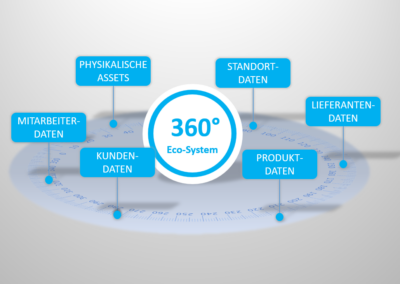
Data ecosystems are highly complex and encompass diverse subject areas (see Figure 1). If they are to be made usable and economically viable, we must take into account all the wishes and needs of the actors as well as any restrictions.
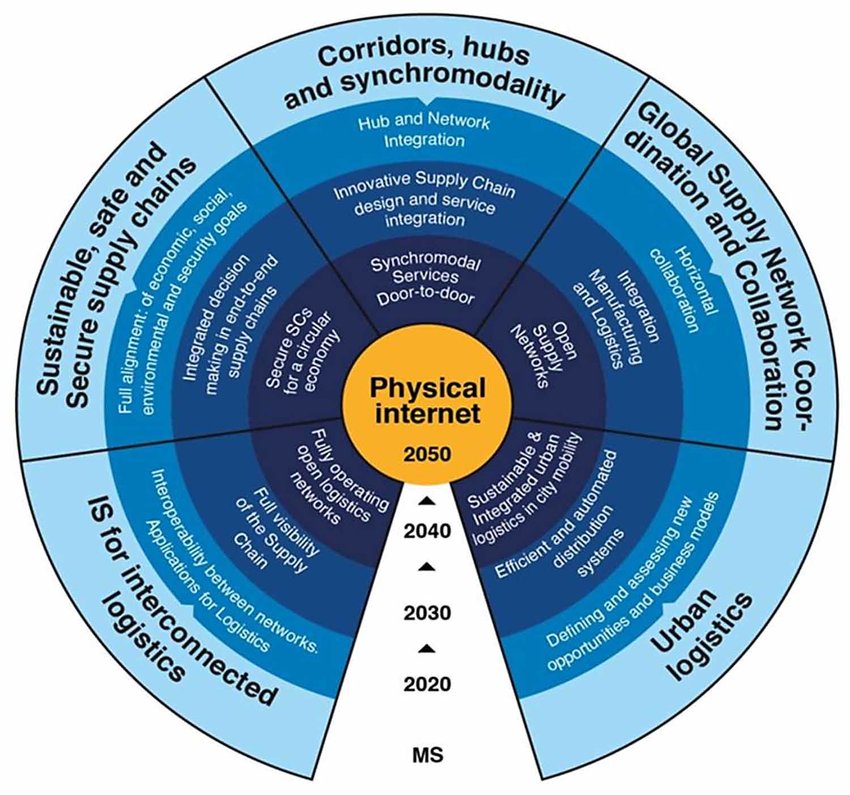
Figure 1: The vision of digital and operational interconnectivity covers highly challenging topics
On the occasion of our Freight 2023 Forum, Dr Matthias Prandtstetter, Senior Scientist and Thematic Coordinator at the AIT Austrian Institute of Technology AIT, and Monika Zosso Lundsgaard-Hansen, Co-Section Head Directorate Operations at the BAV, provided insights on the current status of initiatives and considerations. The experts agree: progress in the rail sector will be a long and difficult affair.
In small steps to the big vision
The target image of an intelligent and possibly self-deciding data ecosystem could be realised through the following development phases as examples (not exhaustive):
1. provide basic data (e.g. with MODI)
- Guaranteed quality
- “Uniqueness” of the data set (i.e. clear definitions)
- Accessibility/transparency for all those involved
- Market-based development of apps and extended functionalities possible
2. activate hub for exchange of data (e.g. DX Intermodal by Hupac)
- Exchange between 2 or more companies operating on the hub
- Additional data sets (with or without restrictions for individual actors/companies)
- Booking possibilities for individual or entire relations
3. create data ecosystem
- Ensure access to historical data for initial analysis possibilities
- Connect databases (basic data and/or data sets available with restrictions)
4. use blockchain technology
- Data and data sets are optimally networked
- Absolute cost and price transparency
- Increased security in data exchange
- More efficient overall development and processing
5. realise the vision of a physical internet
- Open global system based on physical, digital and operational interconnectivity
- Applies protocols, interfaces and modularisation
- Certain decisions are made by the ecosystem – not by individual players
Currently, the rail sector is in phase 1 and 2, even if only selectively. With the Federal Act on Mobility Data Infrastructure (MODIG), the FOT is addressing all relevant topics. DX Intermodal is already operational in combined transport (CT) and takes up points from phase 2. An overall benefit for rail freight logistics can only be achieved if all forms of freight transport production and the entire transport chain (“door-to-door”) are taken into account. To this end, elements of artificial intelligence must be integrated.
Exploiting the inexhaustible potential of data
Big Data has transformed from hype to megatrend; the potential of collected data is almost infinite. This enables disruptive, innovative, digital business models and better predictions for correct business decisions. However, this only applies to data that is available in the right quality and granularity. In addition, the actors must be able to extract the right information and thus the desired knowledge from the data and to interpret and use it correctly. This poses a number of challenges for the ecosystem partners:
System benefit vs. self-benefit
Some companies already have in-house data systems. They collect data from devices on locomotives and wagons and use it for optimisation or pass it on to third parties. This gives them a competitive advantage and additional sources of revenue. Why should such companies participate in data ecosystems? Because optimising their own system does not necessarily serve the system as a whole or the end customer. If, for example, various individual players sell the same data to third parties for a fee, the system becomes more expensive because money flows for each data transfer. In addition, individual actors can combine their data sets within the framework of a data ecosystem and thus promote the efficiency of the entire system, for example the estimated time of departure or arrival. In this context, questions of data sovereignty need to be clarified.
Obligation vs. voluntariness
The state is and remains the biggest financial backer of the rail system. It should have an interest in relieving its own coffers and thus the taxpayers. The provision of non-profit data can improve efficiency. Again, questions remain: Should ecosystem partners be obliged to provide datasets? Should it be possible in a data ecosystem to offset previous, individual investments or to contrast subsidies received? Or should participation in a data ecosystem remain voluntary, with the risk that too few participants feed the platform with data?
Data vs. data
Not every data element is equal for a data ecosystem. Thus, it must be clearly defined from the beginning with which goal and overall benefit an actor should deposit its data elements on a data platform. In addition, a distinction must be made between operational, technical and commercial data in order to avoid emotional discussions. Finally, the quality ensured by the data owner or a newly created quality body determines the credibility and sustainability of a data ecosystem.
We should stay in the conversation
We at the VAP want to make the potential of data ecosystems available to the entire rail sector and increase its competitiveness. That is why we are committed to various initiatives, research projects and established products in this context, namely the following:
- Further development of the mobility data infrastructure MODI, together with the BAV.
- Common European Mobility Data Space (EMDS), an EU initiative
- Logistics Working Group (AKL), in which we have taken over the leadership
If you too would like to help shape the digital future of the rail sector, Jürgen Maier looks forward to hearing from you.
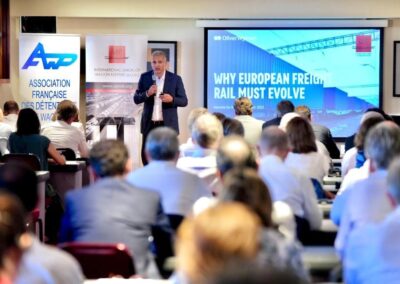
Keepers’ Summit 2023: Adapting to customer requirements and a visionary future for rail freight transport
What it’s all about:
- UIP Keepers’ Summit in Nice
- Customer focus and transformation for rail freight in Europe
- David Zindo new President of the UIP
The International Union of Wagon Keepers (UIP) in collaboration with its French member association AFWP welcomed 120 freight rail stakeholders from across Europe to its annual flagship conference, the Keepers’ Summit, in Nice, France on 15 June 2023. Discussions focused on how environmentally friendly features of rail freight can be used to address climate change while appealing to customers and attracting young talent. The panelists and the audience agreed: rail freight has an important role to play in the future of our society. However, this can only be achieved if rail freight operations transform away from state monopolies towards private sector competition.
In search of change, former UIP President Dr Heiko Fischer challenged the audience to look to the past to better prepare for the future. As the driving force behind the creation of the General Contract of Use (GCU), Mr Fischer pointed to the important role of private wagon keepers in developing rail freight solutions. As a convinced and visionary man, he always placed great emphasis on the need to innovate and transform rail freight to meet the future challenges and expectations of customers and society. The audience acknowledged with standing applause the commitment and achievements of Dr Fischer, who had guided the destiny of UIP as President for 11 years.
Mr Joris D’Inca, Global Head of Logistics at the international management consulting firm Oliver Wyman, confirmed in his keynote speech the need for rail freight to adapt to evolving customer requirements: «Customers expect complete transparency along the transport chain. They place the greatest value on the availability of real-time information and effective corridor management, among other things. Only by adapting to these and other requirements will rail freight be able to gain market share from road freight and play a greater role in combating climate change.» Presentation Joris D’Incà
The expert panel, moderated by Ms Emilie Soulez and composed of Mr Charles Puech d’Alissac (VIIA/Naviland), Mr Paul Mazataud (SNCF Réseau) and Mr Stéphane Gavard (Streem), dove deep into the elements at the heart of the transformation needed to meet the new expectations. Mr Mazataud confirmed SNCF Réseau’s needs and intentions to offer more transparency in maintenance operations, but also RNE’s plans to increase flexibility by adapting the timetabling process. Mr Puech D’Alissac highlighted the elements and benefits of combined transport and the business model behind the activities of Naviland and VIIA. He pointed out the progress made in digitising the interface with customers and encouraged all stakeholders to redouble their efforts in digitising the interfaces between rail freight actors. Mr Gavard provided insights into wagon innovation both in terms of concept and industrial manufacturing, but also explained Streem’s project to develop skills and knowledge in the industry.
Finally, Mr David Zindo, CEO of Streem Group and newly elected UIP President, concluded with a promise: to support the transformation with clear priorities while allowing freight wagon keepers and associations to benefit from the success of the past in order to increase the attractiveness and competitiveness of rail freight. He stressed the importance of the work of UIP and the national federations, which act as consolidated voices and link to local and European political institutions.
«Our societies need to understand the unique selling proposition of rail freight as a crucial means to decarbonise the transport sector. We as a system need to improve our offer to meet the needs of customers, but also to attract and train young talent.» – David Zindo
|
David Zindo becomes new UIP President: A vision for the future of rail freight transport David Zindo will be the new President of UIP, succeeding Dr Heiko Fischer, who led UIP as President for 11 years. Zindo was elected during UIP’s General Assembly on 15 June 2023 in Nice, France. He is supported by Vice Presidents Per-Anders Benthin (CEO of Transwaggon) and Johann Feindert (CEO of GATX Rail Europe). Mr Zindo brings extensive experience to the position, being CEO of Streem Group (formerly Ermewa Group) and a member of the UIP Executive Board since 2015. He previously held senior finance positions at SNCF, Geodis and Veolia Environmental Services. As the new UIP President, David Zindo’s vision is to further strengthen UIP by setting clear priorities, strengthening the team and building alliances with other associations. He wants to strengthen the role of freight wagon keepers in the supply chain and explain the complex EU regulatory landscape. With his long experience and commitment to rail freight, Mr Zindo aims to transform the sector to meet future challenges and the expectations of customers and society. Read more about the newly elected President’s vision in UIP’s interview with David Zindo. |
-
The International Union of Wagon Keepers (UIP) was founded in 1950 and has its headquarters in Brussels. It is the umbrella organisation of national associations from 14 European countries, representing more than 250 wagon keepers and Entities in Charge of Maintenance (ECMs). The fourteen member countries are: Austria, Belgium, Czech Republic, France, Germany, Hungary, Italy, the Netherlands, Poland, Spain, Slovakia, Sweden, Switzerland and the United Kingdom. As the voice for more than 234,000 freight wagons, UIP represents half of the total European freight wagon fleet and is one of the most important resources for the freight rail sector in Europe. Research, lobbying and constant exchange with all stakeholders and organisations interested in the rail freight sector play an important role for the association to direct all efforts towards increasing efficiency in the rail freight service. Through participation in many working groups and committees at European and international level, UIP brings the perspective and interests of freight wagon keepers and works in cooperation with all interested parties to secure the long-term future of rail freight. UIP is recognised by the European Commission as a representative body in the rail sector.

Titus Büter from Swiss Post wants fast and punctual freight trains
Titus Bütler is Head of Transport at Post CH AG and has been responsible for all letter, parcel and newspaper transport by rail and road in Switzerland since the beginning of 2022. Previously, he managed the Frauenfeld parcel center for over 20 years, where up to half a million parcels are processed daily. He also designed the network expansion with the new parcel centers in Cadenazzo, Vétroz, Untervaz and Ostermundigen. In an interview with VAP, he explains the importance of rail transport for Swiss Post.
Here’s what it’s all about:
- How high is the share of rail in the modal split at Swiss Post?
- Customer demand for fast delivery is increasing
- “Pain points”, or optimization potential in rail freight transport
- Swiss Post is the European leader in the transport of goods by rail
VAP: Mr. Bütler, Swiss Post’s yellow trains are striking. More and more, yellow trucks can also be seen on the roads. Is this impression deceptive?
Titus Bütler: Our trucks with the yellow containers do attract attention. Our customers are increasingly demanding fast delivery: picked up in the evening and delivered the next morning. So we’re not talking about 24-hour delivery, but about 15 to 20 hours – and that to any place in Switzerland, whether urban or rural. So we are under time pressure throughout the supply chain. This makes it difficult to bundle parcel volumes to fill entire trains. We choose to go by rail wherever it makes ecological and economic sense. Around 50 percent of all letters and parcels already make at least part of their journey by train. A short train with one or two wagons makes no sense – not even ecologically.
What is stopping Swiss Post from using rail for the transports we see on the road?
We are working with our transport partner SBB-Cargo to shift more parcel shipments back onto rail. We need fast and regular express routes. The average speed of some postal trains is below 50km/h, even though we have fast rolling stock and run light trains. That is too slow.
How do you see the future of postal logistics, will there be more by rail or by road?
We clearly want to bring more volume onto the railways, especially on the west-east axis.
Swiss Post’s newly planned centers do not have rail connections. Why?
In recent years, we have put several small parcel centers into operation. Terminals require land, make the project more expensive and delay realization. Planning and construction were carried out under time pressure: in some cases, less than 2 years passed between the decision on the location and the opening. Where possible, however, we use terminals in the vicinity, e.g. in the case of Cadenazzo, the SBB terminal. Parcels to and from southern Switzerland travel by rail.
Parcels and letters are not considered so-called “rail-affine” goods. What competencies do you have as Swiss Post, as a shipper, to ensure that these goods are nevertheless transported by rail?
We are the only postal service in Europe that transports such goods by rail on a large scale. The prerequisite is that the inclusion of rail is already taken into account in the design and – even more important – that there is an infrastructure that allows fast freight trains with high punctuality at all. We have experts in our team who are very familiar with rail freight transport.
Swiss Post has the same owner as SBB Cargo. Is this more of an opportunity/simplification for you? How would you describe this relationship?
The transports were put out to public tender. The ownership does not play a role. We have a clear customer-supplier relationship, just like other transport companies. Our requirements in terms of punctuality and reliability are very high and we are very satisfied with the services provided by SBB Cargo.
If the fairy godmother were to grant you one logistical wish, what would it be?
I would wish for regular and fast train paths on the west-east axis.
How would you describe the VAP?
We are one of the largest siding owners and one of the largest rail shippers in Switzerland. The VAP represents their legitimate interests at various levels and networks the players among themselves.
What strengths do you attribute to the VAP?
The VAP is indispensable for the political work of all players in rail freight transport.
To whom would you recommend cooperation with the VAP?
Every company that owns tracks or wagons or is active in rail freight transport – whether as a customer or as an RU – benefits from the VAP.
What has not been said yet:
Our mail trains are important to us. We use them to connect Switzerland quickly, reliably and ecologically. That is why it is important to us that the image of slow and often spray-painted freight trains does not rub off on our mail trains.
Mr. Bütler, thank you for the interview and the interesting insights.
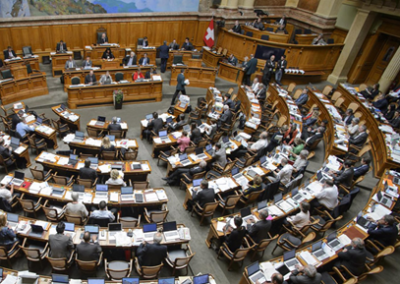
Transport policy decisions of the summer session 2023
In the summer session from 30 May to 16 June 2023, various sector-relevant business was discussed. The results are largely in line with our expectations. However, we regret the missed opportunity to link the proposal for the agglomeration programme with the expansion of the national road network in order to further develop projects and transport modes as an overall system.
That’s what it’s all about:
- More financial means for the rolling road (Rola), we demand quality control.
- Yes to simplified approval of rolling stock for international rail traffic
- Yes to modernisation and expansion of the Swiss national road network
- Yes to the Agglomeration Transport Programme – regrettably without a link to the expansion of the national road network
- Interpellation on the renationalisation of SBB Cargo
Accompanied combined transport (Rolling Road, Rola):
On 1.6.2023, the Council of States dealt with the Federal Council’s dispatch of 30 September 2022 on the amendment of the Freight Traffic Transfer Act and on a federal resolution on a payment framework for the promotion of accompanied combined transport (Federal Council business 22.064). Following the National Council, the Council of States has now also decided to support the “Rolling Highway” (Rola) until the end of 2028 instead of only until 2026 as proposed by the Federal Council. The Confederation can provide a total of CHF 106 million for this support between 2024 and 2028.
With regard to the 2023 modal shift report, the VAP recalls its still outstanding demands:
- Technology-neutral promotion of transports, especially in selected regions with volume potential.
- Quality control also for conventional transports
We consider the one-sided promotion and quality control only in UCT as a missed opportunity. The potential of conventional transport should also be fully exploited – with appropriate application of the modal shift measures, i.e. financial support and quality control.
Amendment of the Railway Act within the framework of the 4th EU Railway Package:
On 13.6.23, the Council of States approved bill 23.024, according to which the European Railway Agency (ERA) is to be responsible for the approval of rolling stock in international rail traffic. Railway companies should no longer have to go through separate approval procedures when introducing new trains in several countries. The Federal Council is now seeking the permanent adoption of this EU solution, which will require an amendment to the overland transport agreement with the EU. The business will now be submitted to the National Council. The VAP supported this draft amendment (see blog article: Revision of the railways act guarantees access to the EU railway network), as it allows for further steps towards harmonisation of regulations in railway operations and facilitates the adoption of this package in the land transport agreement.
Payment framework for national roads 2024–2027 and expansion step 2023:
The Federal Council is planning to modernise and expand the Swiss national roads network with a budget of around CHF 12 billion. Of this, around CHF 8 billion is earmarked for operation and maintenance, while CHF 4 billion is to be allocated to special expansion projects. We at the VAP support this bill and emphasise the importance of a sustainable transport infrastructure for multimodality and modal shift. On 30.5.2023, the National Council decided to allocate as much as CHF 5.3 billion to expansion projects instead of the CHF 4.4 billion requested by the Federal Council. In addition to the five projects included in the federal decree, the National Council considers the extension of the A1 on Lake Geneva to be equally urgent. The Council of States will vote on the bill next.
Commitment credits for agglomeration transport from 2024:
The National Council approved contributions of over CHF 1.6 billion for the new agglomeration transport programmes. A slight increase was made for the Moscia-Acapulco road tunnel in Ticino. We support this federal decision, which is intended to promote transport infrastructure projects in Switzerland’s conurbations in order to create a more efficient and sustainable transport system.
Regrettably, however, NR Wasserfallen’s minority motion was rejected. This called for the bill on the proposal for the agglomeration programme with the expansion of the national road network in order to consider projects and transport modes as an overall system. This should prevent projects and modes of transport from being played off against each other. We consider this a missed opportunity. In the event of a referendum, we will oppose it, in the interest of the country’s security of supply.
See also our commentary on LinkedIn: Billions approved for agglomeration transport programmes: National Council misses chance for holistic transport system
SBB Cargo back in the lap of the state: What’s the point?
With his interpellation «SBB Cargo zurück im Schoss des Staates. Was soll das?» (SBB Cargo back in the lap of the state. What’s the point?), NR Christian Wasserfallen FDP/BE is asking the Federal Council for an assessment of the SBB Group’s decision to take over 100% of the share capital of SBB Cargo and to place SBB Cargo directly under the management of the Group. This unilateral change in the market and power structure is detrimental to the portents of the pending reform of the framework conditions for Swiss freight transport. The VAP welcomes the questions put to the Federal Council.
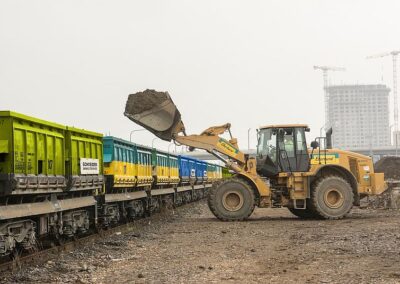
Sensible modal shift – from shipper to rail forwarder
In the canton of Zurich, clean excavated material from excavation pits with a volume of more than 25,000 cubic metres must be transported away by rail by the builder-owner from 1 July 2021, otherwise a replacement fee is owed. The companies HASTAG (Zürich) AG, Schneider Umweltservice AG and Eberhard Bau AG have merged to form the newly founded company TerraRail Modalsplit AG as of 8 March 2022 to offer this service.
This is what it’s all about:
- Canton of Zurich: ordinance on the transport of excavated material and aggregates by rail (BTV).
- TerraRail: Provider for transport of excavated material and aggregates by rail.
- In the interests of fair competition: invitation to tender for RUs
TerraRail Modalsplit AG offers the transport of excavated material and aggregates by rail at four locations. In doing so, they make use of their many years of experience and the ideal locations with rail connections of the three companies. Traction between the sites and the unloading point(s) is currently provided by SBB Cargo.
The excavated materials are transported by rail from the agglomeration area and deposited or recycled in a landfill. Ideally, raw material such as gravel is transported again directly. The offer also includes the development of a transport concept, which must be submitted with the building application.
TerraRail is currently using SBB Cargo for the transport by rail. However, other RUs were also considered. TerraRail Modalsplit AG acts independently of the providers in the market and obtains several offers during the bidding and production planning process. The most suitable offer is confirmed. Therefore, changing constellations are to be expected in this area.
It is expected that there will be competing offers, as TerraRail’s offers are placed under competitive conditions. In fact, several awards have already been made to other suppliers in the market. This indicates the existence of competition.
Rail transport is attractive when the rail infrastructure leads directly from the place of loading to the place of unloading and over longer distances. However, this is rarely the case in the modal split area. As a rule, an additional reloading process is required, which increases the effort and requires loading places. For this reason, from TerraRail’s point of view, legal requirements make sense in order to increase the modal split share of rail transport and to relieve the roads. At the same time, TerraRail is working to continuously improve the competitiveness of this transport chain.
The VAP approves of the bundling of the competence of private-sector companies and the organisation of a transport chain based on the strengths of all partners. The three shippers, in their role as specialists in earthworks and mining and operators of suitable transhipment platforms in their sidings and now as rail forwarders, are shifting transports to the railways and relieving the burden on the roads. Competition and the pursuit of real competitiveness compared to pure road transport are viewed positively. It is desirable that shippers have a choice and that supply security is increased by the existence of several rail providers.
The solution found in the canton of Zurich with the replacement levy on builders is a compulsory measure designed in a market economy, where the revenue flows into the general state budget and is not earmarked for a specific purpose. We would welcome a targeted reimbursement to the market players, for example in the form of financial support from the canton for the construction of transhipment platforms or the development of new multimodal logistics solutions.
For other products, a comparable model is much more difficult to implement, as the necessary transhipment platforms are lacking. Here, cantonal transport and spatial planning is called upon to ensure that locations are well connected by road and rail.
In order to promote further positive relocations, the VAP also assumes an advisory role for the cantons. In doing so, the cantons benefit from the association’s extensive expertise, many years of experience and far-reaching network, which is firmly anchored in the transport industry.