
The VAP promotes freight transport by rail.
The VAP Association of Shippers campaigns for market-oriented framework conditions and an attractive Swiss rail freight system. Relevant topics:
Freight industry
- How do we shape the future of freight transport?
- What moves the freight industry?
- An overview of the players in rail freight transport.
Network
Here you will find useful information on railroads, their organization and network access.
Financing
Information on financial support and charges in freight transport.
Sites
Everything about free loading, terminals, sidings or even multimodal logistics hubs.
Interoperability
The VAP is committed to harmonizing the framework conditions so that trains can run effortlessly on European rail networks.
Sustainability
For a far-sighted future, various areas need to be designed sustainably.
Innovation
How can we drive innovation in freight transport?
Operations
In favor of fair competition, we want to utilize the strength of all modes of transport and combine them optimally. Because this makes the route shorter – and more economical – for everyone.
Events
Here you will find further information and documents on our events Forum Freight Transport, our General Assembly and others.
Setting the right track for inland freight transport by rail
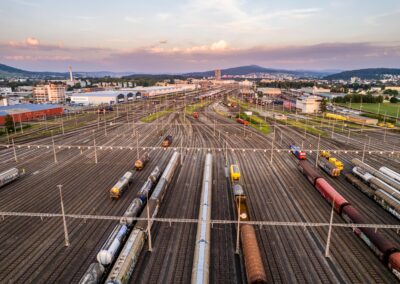
The Federal Council released its message on the Goods Transport Act to the Parliament in January. It aims to modernize the comprehensive single-wagon load transport (EWLV) and establish the foundation for its economic viability. Despite various reservations, the Federal Council proposes investment subsidies, temporary operating compensations, and incentives for shippers.
Key Points:
- Federal Council aims for economic viability
- EWLV to undergo fundamental restructuring and modernization
- Support for EWLV operation during the modernization phase
- BAV criticizes industry guidelines
- Overview of the proposal
- What’s next
Federal Council aims for economic viability
On January 10, 2024, the Federal Council adopted the message on the Goods Transport Act (in German) for Parliament. We, from VAP, welcome the continued pursuit of the favored Variant 1. With this proposal, the Federal Council intends to modernize rail freight transport technically and organizationally, strengthen multimodal transport chains, and better integrate shipping. The overarching goals are to enhance supply security nationwide, promote multimodality, and contribute to the federal environmental and energy targets. This involves securing current area coverage, gradually increasing the share of rail freight transport, and laying the groundwork for economically independent operation.
EWLV to undergo fundamental restructuring and modernization
The basis for this is a comprehensive restructuring of the EWLV, or network traffic, with associated technological modernization (especially digitization), integration into the Swiss logistics system, and the establishment of non-discriminatory intramodal competition. The latter is expected to significantly improve the quality and efficiency of logistics services and simplify future innovations. The proposal allocates investment funds of CHF 180 million for the introduction of digital automatic coupling (DAK). Additional investment funds are earmarked for digitized process optimizations, data exchange platforms, and similar initiatives.
Support for EWLV operation during the modernization phase
To maintain current area coverage, the operation will be financially supported for eight years during the modernization phase. Allegedly uncovered costs will be covered, and compensations will decrease in line with the progress of the restructuring, determined in multi-year performance agreements with all freight railways involved in network traffic.
BAV criticizes industry guidelines
To ensure the success of this transformation and stable EWLV operation during the restructuring phase, the industry has proposed guidelines for specific measures and support criteria. However, the Federal Office of Transport (BAV) criticizes these as insufficient and demands further revisions. It particularly highlights the lack of perspective for a comprehensive redesign to enhance efficiency and utilization, foreseeing a tendency towards structural maintenance and further service reduction. The VAP understands the BAV’s reservations, as the guidelines represent a compromise between shippers and freight railways, with significant concessions made by VAP in the interest of the cause. Substantial revisions are now necessary, especially from the perspective of freight transport customers as users of logistics services.
We are prepared to significantly support further development. A comprehensive operational control system is seen as a crucial prerequisite for this transformation, serving as an evaluation tool for the effectiveness of measures and incentives, along with the establishment of a digital platform. The transformation should be methodically structured and implemented in a targeted manner as a project.
Overview of the proposal
- Investment subsidies: The Federal Council allocates CHF 180 million for the introduction of DAK, covering approximately one-third of the restructuring costs. The conversion of rolling stock must be coordinated across Europe and is expected to be completed by 2033. DAK is anticipated to substantially improve the productivity and quality of rail freight transport.
DAK Factsheet (PDF, 971 kB) - Operating compensations: To maintain EWLV at the current comprehensive level during the restructuring phase, the Federal Council proposes to financially support it for eight years on a degressive basis. By the end of this period, economic viability should be achieved. For the first four years, it requests CHF 260 million.
Freight Transport Factsheet (PDF, 712 kB) - Incentives for shippers: Permanently planned are handling and loading contributions, along with compensation for the uncovered costs of the ordered freight transport service, totaling CHF 60 million per year.
Read the complete message on the Goods Transport Act.
What’s next
- In the first half of 2024, open points between BAV and the industry will be discussed, and guidelines will be supplemented and clarified accordingly.
- Within this framework and following the approval of the revised law, a tendering process for various service packages within network traffic is expected to start by the end of 2024.
- Negotiations on potential performance agreements are planned for 2025, allowing any support measures to take effect in early 2026.
For further details, refer to this joint press release from VAP, LITRA, ASTAG, IG Kombinierter Verkehr, and VöV.
Flexibilisation of train path protection for freight transport
That’s what it’s all about:
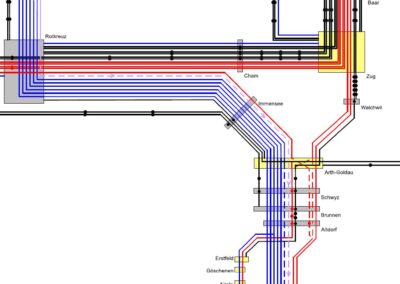
- Network utilisation concept and plan (NNK/NNP) secure train paths for goods trains in the long term
- Unused freight train paths – demand from passenger transport
- Motion 23.4259 Method for determining train paths for long-lasting construction sites
- Temporary flexibilisation only with binding agreement to solve the bottleneck
Network utilisation concept and plan (NNK/NNP) secure train paths for goods trains in the long term
As part of the «Financing the railway infrastructure» bill in 2013, infrastructure expansion targets for freight transport were defined in Art. 48a lit. b of the Railway Act (EBG). These include improvements for domestic, import and export traffic as well as improving the availability of train paths. As part of the draft revision of the Freight Transport Act, the so-called network utilisation concept and the network utilisation plan were introduced in 2015 as a means of securing available freight train paths. With these instruments, the long-term expansion and utilisation planning of the railway infrastructure is designed to ensure the availability of a minimum number of train paths per hour and direction on the various network sections for freight and passenger transport. The service concepts and rolling timetable planning must be developed along these available train paths. If, through skilful capacity planning in the timetable procedure, more train paths are ultimately available in the annual timetable than provided for in the NNK/NNP, they are also available to the train path allocation body for allocation.
Unused freight train paths – demand from passenger transport
As freight transport, unlike passenger transport, cannot be planned in the long term and depends on current market conditions, secured freight train paths are regularly not utilised. This is unproblematic as long as there are no conflicts with passenger transport. However, in the case of construction sites, as is regularly the case on the Swiss network due to ongoing expansion and necessary maintenance work, conflicts are practically inevitable. If freight train paths are actually not used in such constellations, the passenger transport industry and the cantons are understandably very unhappy.
Motion 23.4259 Method for determining train paths for long-term roadworks
With motion 23.4259, NR Cottier FDP/NE is asking the Federal Council for a method to improve the allocation of train paths in the event of long-term construction sites. The aim is to create the possibility of allocating unused freight train paths to passenger transport for the duration of construction sites. The Federal Council is asking Parliament to reject the motion, as the desired flexibility is provided by the current planning system. Unused freight train paths can be allocated to passenger transport.
Temporary flexibilisation only with a binding agreement to solve the bottleneck
The petitioner’s concern is understandable. The VAP has also signalled to the cantons on various occasions that it will not refuse the desired flexibilisation of train paths. However, this cannot mean a fundamental renunciation of securing freight transport routes à la longue. Rather, an appropriate solution must be agreed for each conflict on a case-by-case basis. In the case of structural conflicts in particular, for example as a result of unforeseen expansions in passenger transport services that are not of a temporary nature and therefore preclude the future safeguarding of the freight train path concerned, a corresponding structural solution must be agreed as part of the next expansion phase. However, this is legally difficult to implement, as it is Parliament that decides on the expansion stages and credits and not the affected cantons and industry representatives.
Possible solutions are currently being sought at a round table, using the example of the service between Neuchâtel and Geneva. The VAP will participate as a representative of customers, who can also order train paths, in an endeavour to find balanced solutions.
At the end of 2023, the FOT also started work on the evaluation of NNK and NNP. The aim is to evaluate the instruments that have now been in use for a considerable period of time with regard to any need for improvement. The VAP is actively involved in this working group.
Rail Connections Charter 2024: a broad-based initiative for a strong rail system
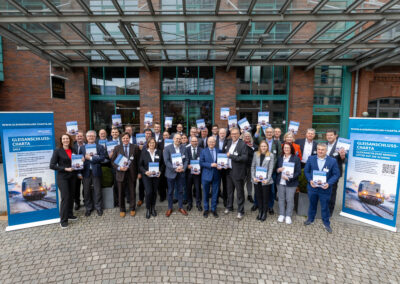
On 31 January 2024, the rail sector presents the siding charter to the representative of the German government in Berlin. Signed by 56 associations across Europe, the initiative sets out concrete measures for the successful transformation of rail freight transport as part of multimodal logistics based on sidings and customer-oriented access points.
That’s what it’s all about:
- A better future for sidings and access points
- Key areas of action and concrete implementation proposals
- Utilising the strengths of the railway across national borders
A better future for sidings and access points
On 31 January 2024, the new siding charter was presented to Michael Theurer, Parliamentary State Secretary and Federal Government Commissioner for Rail Transport. This is a milestone for the future of rail freight transport in Europe and Switzerland. The co-signatories want to improve the future prospects of rail sidings and multimodal access points. We at the VAP have been involved in various working groups and have contributed our knowledge and experience. Regular dialogue of this kind is key to improving developments in the future of Swiss rail freight transport and its international connections.
Key areas of action and concrete proposals for implementation
The charter sets out five overarching goals and specifies measures that are crucial to the attractiveness and survival of rail freight transport.
- Support people who make and implement decisions. In the context of this claim, it is important to communicate the system knowledge and the possibilities of rail freight transport for multimodal logistics chains to political decision-makers.
- Equip the economy with access points and upstream infrastructure as required. In addition to securing and possibly expanding suitable locations, this also includes targeted financial support.
- Improve framework conditions for railway sidings and loading points. This primarily means reducing regulatory requirements and bureaucracy.
- Offer multimodal transport solutions via sidings and loading points. Rail freight transport is part of a multimodal logistics chain. Freight customers therefore need incentives for overall offers with a high proportion of rail transport from various providers.
- Use modern and innovative technologies. The transformation and use of new achievements such as digital automatic coupling (DAC) or data platforms is absolutely essential for rail freight transport (see blog post «Ready for the next level of digitalisation»).
Utilising the strengths of the railway across borders
The Siding Charter 2024 is supported by 56 associations, organisations and initiatives from the fields of industry, trade, logistics, construction, agriculture, timber, recycling and local authorities – including the VAP. These stakeholders will continue to participate in future work to refine and implement the solutions, and not just in Germany. After all, rail freight transport should be able to develop its strengths across national borders. Interested parties from Switzerland are welcome to contact Jürgen Maier.
Statements:
Joachim Berends, Vice President of the VDV Association of German Transport Companies:
«Since the first edition in 2019, many of the charter’s proposals have already been implemented or are in the process of being implemented. But we are still a long way from reaching our goal, and further topics have been added. 56 signatory organisations are proposing measures to strengthen Germany as a business location with more and modern sidings – and to protect the climate.»
Dr Helena Melnikov, Managing Director of the German Association of Materials Management, Purchasing and Logistics (BME):
«We support the central demands of the charter to the best of our ability. The most important thing now is to reduce bureaucracy and simplify regulations. At the same time, the promotion of sidings must be improved, more commercial areas must be connected to the railways and new transport concepts must be created that incorporate sidings.»
Dr Frank Furrer, Secretary General of the VAP Association of the Shipping Industry:
«The cantons are already developing logistics and freight transport concepts for favourably located sites with good road and rail connections.The dispatch on the Freight Transport Act aims to lead rail freight transport out of archaic production conditions and make it fit to play a central role in multimodal logistics chains.The charter and dispatch therefore complement each other ideally for import and export transport.»
Focus RailCom: presentation of key people
This is the issue:
- The Commission guarantees non-discriminatory access
- Who is behind the Commission? We would like to introduce you.
RailCom guarantees non-discriminatory access to Switzerland’s rail network, combined transport transhipment facilities and local freight services. The Commission is actively committed to an open and fair market access policy in order to promote healthy competitiveness and increase the efficiency of the rail sector.
In this blog post, we introduce the staff who are committed to RailCom.
Chairmanship:
- Chair: Patrizia Danioth Halter, lic. iur., attorney-at-law and notary, LL.M., Altdorf (UR)
- Vice-Chairman: Markus Kern, Prof. Dr. iur., LL.M., Professor of Public, Administrative and European Law at the University of Berne (BE)
Members of the committee:
- Cesare Brand, lawyer, Forel (FR)
- Anna Ciaranfi Zanetta, Lawyer, Department of Finance and Economy of the Canton of Ticino, Dalpe (TI)
- Barbara Furrer, Dr. iur., attorney-at-law, Head of Legal Services, DHL Express (Schweiz) AG, Hedingen (ZH)
- Manfred Haller, EMBA, independent consultant, Unterkulm (AG)
The secretariat provides professional and technical support to the committee. It follows the Commission’s instructions. It is administratively attached to the General Secretariat of the Federal Department of the Environment, Transport, Energy and Communications (DETEC). Its members are as follows:
Head:
- Christof Böhler, M.A. HSG International Relations
- Deputy: Melissa Rickli, lic. phil. hist.
Staff members:
- Ana Dettwiler, Lawyer, Legal Affairs
- Ursula Erb, Doctor of Economics, Market Monitoring
- Andreas Oppliger, lic. phil. nat, Market Monitoring
- Katrin Suter-Burri, Ph. ETH, Communication, Agenda and Research
Stability as an indispensable basis for international transport cooperation
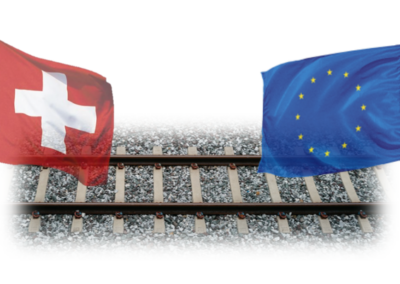
Once again, the status quo was saved in the Joint Committee on the Land Transport Agreement, despite the gloomy outlook. In 2024, the EU will once again grant Switzerland limited access to the ERA data platform OSS for one year. How long does Switzerland want to continue working with these dithering parties?
That’s the question:
- What is the aim of the Federal Office of Transport?
- Why is international cooperation important?
- Switzerland must move
- Stability is central to solving upcoming tasks
What is the Federal Office of Transport’s goal?
Trains should be able to travel across borders with as few obstacles as possible. The Swiss standard-gauge network forms a central part of the interoperable European rail network (Single European Railway Area). To make this possible, the FOT periodically harmonises the sovereign Swiss railway regulations with the current European rules of the Interoperability Directive and the Safety Directive. Switzerland should be able to act as an equal partner to the member states in the area of responsibility of the EU Transport Commission (DG MOVE). The overland transport agreement plays a central role in this bilateral cooperation. Ratified agreements create legal certainty and predictability.
Why is international cooperation important?
The EU wants to completely overhaul the existing national railway system and develop it into the strong mode of transport of the future. In future, modern trains are to run across borders on an efficient and standardised rail network without any obstacles. For this far-reaching transformation, rail operations must be redesigned from the ground up and new standardised systems with transparent interfaces must be developed and introduced. This can only be achieved with centralised coordination and guided cross-border cooperation. The 4th Railway Package, which came into force in 2019, forms the legal basis for this: as a European agency, ERA is now responsible for the technical design of standardised procedures and rules as well as for managing European authorisation procedures. For the necessary developments, the EU created new comprehensive organisations with «Europe’s Rail» as part of «Horizon» and provided them with considerable financial resources. Ministries, railway companies, associations and industry are called upon to actively participate in the ERJU’s numerous working groups, consisting of the System and Innovation Pillars, and to contribute their expertise to shaping the future European railway system. The topic of «DAK» is also an integral part of this organisation.
Switzerland must move forward
Over the past 25 years, Switzerland has adopted many elements from the newly organised EU railway world. Thanks to the proven equivalence, important steps towards integration into the European railway system have been achieved. The Federal Council’s decision to break off negotiations on an institutional agreement (InstA) has also meant that no substantial further development of the land transport agreement has been possible in the transport sector since 2021. Switzerland must now choose between isolation and cooperation.
Stability is key to solving upcoming tasks
The comprehensive transformation of the existing European railways, which are strongly national in character, into a modern, efficient overall transport system requires a joint, coordinated effort – going it alone could have serious consequences. Those who are part of it can participate and play an active role in shaping it.
Switzerland must now do its homework:
- Settle political differences with the EU
- Ensure permanent participation in the «Horizon 2020» research programme
- Update the EU-CH land transport agreement
- Implement the railway package market part (market liberalisation at least in international passenger transport)
- Complete rail package (adapt EBV, ERA membership, recognise ERA authorisations, regulate ERA competences)
- Reactivate bilateral agreements on cross-border routes
Transport and logistics are transnational. The planned migration to digitalisation and automation of the railways requires a willingness to make far-reaching changes on the one hand and major investments on the other. Both will only be possible in an efficient and sustainable manner if there is sufficient clarity about future cooperation.

Ready for the next level of digitalisation
Without digital automatic coupling (DAC) there is no digitalisation and without digitalisation there is no competitiveness. This is how the modernisation of the rail freight sector could be described. However, it’s not quite that simple. Here is an overview of the status quo and the next steps to be taken.
This is what it’s all about:
- Combining hardware and software in a targeted manner
- Financing must provide the initial spark
- «Management Deployment DAK-CH» coordinates the migration
- Test phase: Switzerland at the forefront
Combining hardware and software in a targeted manner
The DAK gets the comprehensive digitalisation of the railway rolling. This is because it offers more than just fully automatic coupling or various tracking functions for individual wagons. It enables a leap forward in Swiss rail freight transport by supplying power and data to the entire train. But that’s not all. Data ecosystems are also required for digitally inspired business models in rail freight transport. The state mobility data infrastructure «MODI» is setting a good example here (see blog post «Data ecosystems: Sharing data to double its added value»). In order to combine hardware and software in such a way that the rail freight sector becomes competitive in multimodal logistics, high initial investments are required. Private companies in the freight transport sector will not be able to bear this alone.
Funding must provide the initial impetus
In Switzerland, the Federal Council adopts its dispatch on freight transport in January 2024 and forwards it to Parliament. A central component of this bill is the funding for migration to the DAK. The Federal Council envisages a funding contribution of CHF 180 million. The calculated investment volume for nationwide DAC migration in Switzerland amounts to CHF 500 million. We at the VAP are taking a leading role in the planning of financial resources. The federal government wants to finance the MODI data ecosystem for the first 10 years and then charge user fees. The European Union (EU) has also yet to fund DAC migration. The EU Commission intends to provide around EUR 200 million for the planned field tests from 2026.
«Management Deployment DAK-CH» coordinates the migration
The cross-industry committee «Management Deployment DAK-CH» will be responsible for coordinating the migration implementation in Switzerland. Among other things, this committee is responsible for the active exchange with Europe’s Rail, the planning of workshop capacities, the material disposition and the verification of the conversions. It must schedule the conversion of the vehicles in advance together with the keepers, as well as with the railway companies and other logistics players. In the meantime, the rail freight companies should determine their requirements for converted wagons according to the volume of traffic.
Test phase: Switzerland at the forefront
The functions and processes of the DAK must be harmonised throughout Europe. One milestone is the definition of the «Starter Package». This defines which functions the DAK migration will start with in Europe. Switzerland is currently actively involved in operational tests of new systems and is contributing pioneering results to the European working groups. Here is an overview of the current tests and projects with Swiss participation:
- The EU is having the rail technology specifications drawn up for the implementation of the «Greening Freight Traffic Package» of the European DAC Delivery Programme (EDDP). Switzerland is actively involved here.
- With «Power-Line-Plus», data is sent via the power supply lines. The Lucerne University of Applied Sciences and Arts is conducting operational tests together with SBB Cargo and providing key insights into data transmission quality. From 2024, proof of operational suitability is to be provided with all the functions of the «Starter Package» and transmission via «Power-Line-Plus», making commercial journeys possible. The FOT is supporting this development financially.
- From 2026, extensive field tests for the operational suitability and reliability of the DAK are planned in Europe with around 100 trains. After that, the aim is to migrate DAK efficiently, including in Switzerland.
- MODI consists of two main elements: The National Data Networking Infrastructure Mobility (NADIM) enables the standardised exchange of mobility data. The national geodata infrastructure «Transport Network CH» can ensure a standardised, digital representation of Switzerland’s entire transport system. MODI is currently only intended for passenger transport. However, freight transport could also benefit from this, for example through the digital networking of public authorities, transport and spatial planning authorities and all stakeholders involved. For this reason, the VAP is in close contact with the responsible offices of the federal administration in order to quickly integrate freight transport into the project.
Gotthard Base Tunnel (#9): Avoid shifting traffic back to the road
The freight train derailment on 10 August 2023 caused serious damage to the Gotthard Base Tunnel. SBB therefore intends to massively reduce the capacity of sustainable rail freight transport in favour of leisure traffic at weekends with the timetable change on 10 December 2023. This could lead to a shift of up to 15% of rail freight back onto the road.
This is the issue:
- New timetable concept cancels rail freight train paths
- Statutory modal shift target jeopardised
- Alternative for passenger transport available
- NEAT gradually misused for other purposes
- No dialogue at eye level
- Avoiding a shift back to road transport together
New train path concept cancels rail freight train paths
According to the media update of 2 November 2023, SBB assumes that the Gotthard Base Tunnel will not be fully operable for passenger and freight trains again until September 2024. The repair work is likely to take far longer than originally expected. SBB officials have announced that with the December timetable change, significantly more and faster passenger trains will be travelling through the Gotthard Base Tunnel at weekends. Among other things, they are cancelling a time slot for rail freight traffic from 7.30 to 9.00 a.m. on Friday mornings and allocating it to passenger traffic.
Statutory modal shift target jeopardised
The unauthorised train path concept has serious consequences for the national modal split. One of our members assumes that 10% to 15% of combined freight transport consignments will be shifted back to the roads and that supplies to Ticino can no longer be fully guaranteed at weekends. Construction work can also not be carried out in the aforementioned time window.
This development contradicts Switzerland’s policy for modal shift. According to this policy, the Federal Council wants to shift transalpine freight transport from road to rail. The statutory target of 650,000 lorry journeys was already clearly missed in 2022: 880,000 lorries were still travelling through the Swiss Alps.
Alternative for passenger transport available
For representatives of the shipping industry, SBB’s new train path concept is all the more absurd as there is a sensible alternative for passenger transport: from an ecological perspective in particular, leisure travellers should use the mountain route at weekends and leave the Gotthard Base Tunnel to the freight trains. After all, due to their heavy loads, they consume much more electricity over the mountain route than passenger trains. Shippers depend on a reliable transport infrastructure seven days a week to supply goods to Switzerland.
NEAT gradually misappropriated
The Gotthard Base Tunnel is part of the New Rail Link through the Alps (NEAT “Neue Eisenbahn-Alpentransversale”). It was designed for rail freight transport. The common goal of the European Union and Switzerland with the NEAT was and is to promote freight transport by rail. The project was realised at a cost of CHF 23 billion and 55% of it was financed by the performance-related heavy vehicle charge (LSVA). By restricting the urgently needed train paths for freight transport, the NEAT is once again being misused.
No dialogue at eye level
According to SBB, “… careful consideration was given to the allocation of train paths through the Gotthard Base Tunnel during the repair work in collaboration with representatives of the freight transport sector and passenger railway undertakings as well as the independent train path allocation body.” However, the new train path concept was developed without the freight transport industry and its customers. The subsequent dialogue also proved to be tough. In addition, the voice of SBB Cargo was missing at the media conference on 2 November 2023. It is unclear whether and how the concerns of the freight transport sector were taken into account within the company. The shipping industry is alarmed by this one-sided approach and sees the previously constructive cooperation with SBB being jeopardised.
Working together to avoid a shift back to the road
We at the VAP strongly urge SBB to involve all those involved in rail freight transport in the planning of train path allocation and to refrain from making one-sided statements about the smooth handling of freight traffic through the Gotthard Base Tunnel. These favour a premature migration of freight transport to the road, which must be avoided at all costs. After all, it is generally difficult to reverse such a move. SBB should not play freight and passenger transport off against each other and favour road transport in the process.
Partial revision of SBBG: responsibility and market liberalisation further delayed
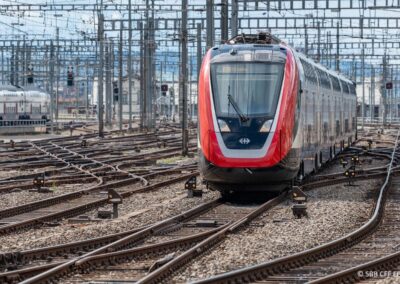
The Committee for Transport and Telecommunications of the National Council (KVF‑N) unanimously supports the proposal for the financial stabilisation of the Swiss Federal Railways (SBBG). In contrast to the Federal Council, it is of the opinion that there is no need to change the system for granting vault loans to SBB. In doing so, the KVF‑N also disregards all of the VAP’s recommendations.
This is the issue:
- 3 billion financial injection for SBB
- SBBG partial revision referred to the National Council
- The industry’s voice remains unheard
- Still no market liberalisation in sight
3 billion financial injection for SBB
In its report of 16 December 2022 on motion 22.3008 «Supporting the implementation of SBB investments and a long-term vision in Covid-19 times», the federal government proposes to cover SBB’s deficits in long-distance transport with a one-off capital injection of an estimated CHF 1.25 billion. It also wants to ease the track access charges for long-distance transport with a further CHF 1.7 billion. It is also proposing a revision of the financing instruments.
SBBG partial revision referred to the National Council
The KVF‑N has unanimously referred the bill to amend the SBBG to the National Council. The majority of the committee also rejects a change in the system of financing instruments, as budget loans, unlike treasury loans, are subject to the debt brake. It is of the opinion that the resulting competitive situation with other federal expenditure is not desirable with regard to public transport services. The National Council will decide on the KVF‑N proposal in the 2023 winter session.
Voice of the industry remains unheard
As published in our media release of 30 March 2023, we at the VAP reject the proposed extraordinary restructuring of long-distance transport with around 3 billion taxpayers’ money. On the other hand, we welcome the proposed correction of the financing instruments, i.e. the waiver of the granting of vault loans to SBB bypassing the federal debt brake. In the blog posts «SBB should take responsibility instead of a CHF 3 billion financial package» and «No stabilisation of SBB despite CHF 3 billion in additional federal funds», we summarise the industry’s position and our corresponding arguments.
Still no market liberalisation in sight
If the bill is accepted, the National Council would further consolidate the SBB monopoly in long-distance transport. This is problematic in terms of European policy, as the EU is demanding that Switzerland open up the long-distance transport market. This unfulfilled demand overshadows the negotiations with the EU on the extension of the temporary cooperation with the European Railway Agency ERA for one-stop-shop authorisations and more interoperability between Switzerland and the EU. Compared to EU member states, Switzerland does not yet have full market access; the Swiss railway network is currently not an integrated part of the European interop network. For this reason, the freight transport-related associations Astag, CFS and we at the VAP are calling for a national migration strategy to open up the market in line with the EU. If the National Council votes in favour of the KVF‑N motion, it will push this issue even further away.
Addendum 20.12.2023, update from the winter session:
In the winter session, a majority of the National Council agreed to grant the Swiss Federal Railways (SBB) a one-off capital subsidy of CHF 1.15 billion to reduce debt. This amount was already included in the 2024 budget. In contrast, the National Council rejected the Federal Council’s proposal to switch from treasury loans to federal budget loans when a certain level of debt is reached. This was based on the argument that applying the debt brake to budget loans could delay the expansion. The chamber also decided to set the appropriate reserve for the railway infrastructure fund (BIF) at a minimum of CHF 300 million, with a maximum of two thirds of the net revenue from the performance-related heavy vehicle charge (LSVA) flowing into the fund. The National Council has thus ignored all of the VAP’s recommendations. The bill now goes to the Council of States, which will hopefully take corrective action.
Gotthard Base Tunnel (#8): Safety and control tasks clearly distributed
The Swiss Safety Investigation Authority (Sust) names a broken wheel disc as the cause of the freight train accident in the Gotthard Base Tunnel. In the news report from 19 October 2023, Swiss television SRF took a close look at the maintenance of freight wagon wheels. VAP expert Jürg Lütscher comments on the safety and control tasks of the players involved – and explains them further in this blog post.
This is what it’s all about:
- Harmonised safety in the European rail freight system
- Maintenance work monitored by independent bodies
- Wheelset inspections in operation and maintenance
- Two inspection procedures established
- Responsibilities and regulations clarified
Harmonised safety in the European rail freight system
Safety in the European rail freight system is based on a triangle of responsibility consisting of infrastructure managers, railway undertakings (RUs) and wagon keepers with their responsible entities in charge of maintenance (ECMs). The specifications and regulations are now largely harmonised throughout Europe. The industry has developed the internationally recognised VPI European Maintenance Guide (VPI-EMG) based on the provisions of the sovereign directives, the applicable technical standards and practical experience. The VPI Germany, VPI Austria and VAP (Switzerland) associations have been pioneering this work since 2007. In 2019, AFWP (France) and UIP (International Union of Wagon Keepers, representing the smaller national associations) were added to the group of editors of the VPI-EMG. This set of rules defines both deadlines and the scope of work and standards in a user-friendly manner. It provides maintenance recommendations that each user must check for applicability to their freight wagons, supplement if necessary and approve for their wagon fleet. More than 550 companies, including wagon keepers, ECMs, repair workshops, authorities and universities, currently use the VPI-EMG. More than 260 repair workshops and mobile service teams from 19 European countries use the VPI-EMG on behalf of the relevant ECM.
Maintenance work monitored by independent bodies
The EU safety directive defines two independent procedures. This is to ensure that the specialised work is carried out everywhere with the required level of quality and knowledge:
- Certification: The companies involved must be certified by independent bodies for security-related activities within the scope of their ECM. They must regularly renew these certificates and allow their customers to view their validity and scope.
- Auditing: Supervisory authorities carry out risk-based audits of safety-critical processes and quality inspections in railway operations. If they uncover weaknesses, they also monitor their rectification.
Wheelset inspections in operation and maintenance
Wheelsets are considered safety-critical components of a rail vehicle. They are subject to continuous wear during operation and can also be damaged by external influences. When maintaining wagons, the ECM ensures that fully functional wheelsets are used.
During operation, the RUs and the train control systems of the infrastructure managers (see blog post «Gotthard Base Tunnel (#2): Automatic train control systems») specifically ensure that no recognisable damage or deviations on wagons jeopardise operational safety. To ensure safe railway operations, the wheelsets must comply with all relevant limit values during the entire operating time. Wheelsets that have been replaced due to deviations or damage are sent to a certified specialist workshop for reconditioning in accordance with the regulations.
Two test procedures established
The SRF news report shows two test procedures for systematic wheelset maintenance. A certified specialist workshop can thus ensure that the wheelsets it repairs do not show any relevant damage in the form of material cracks on delivery. This involves two non-destructive testing methods in accordance with DIN 27201–7, which have become established throughout the industry:
- Ultrasonic testing: Detection of cracks in the wheel face and flange back area
- Magnetic testing: Detection of cracks in the wheel centre and wheelset shaft including wheel seat
Responsibilities and regulations clarified
As many goods are transported across borders, internationally harmonised rules and procedures are important in Europe. In recent years, the regulations have been comprehensively updated and improved. Current versions of the EU Safety and Interoperability Directive apply both in all EU states and – via the overland transport agreement – to the Swiss standard gauge network. Based on this, the Swiss railway sector has developed practical standards and maintenance procedures for the main players. Europe-wide common reporting processes and assessment procedures (see blog post «Gotthard Base Tunnel (#7): Sust report provides clarity») ensure that industry players learn their lessons from an operational incident such as that of 10 August 2023 and implement effective improvements in maintenance.