
FINANCING
Financing is a topic where it is worth taking a closer look.
Hearing
Taxes, levies
- 31.08.2022: Federal Council decides to modernise the collection system for the Distance-related Heavy Vehicle Fee (HVF)
- Information on the Heavy goods vehicle charge (HGVC)
- HVF calculator from ASTAG
- Renewal of the technical infrastructure of the Heavy Vehicle Fee (HVF) as of 2025
- National consumer price index
Financial aid

Strengthen fair competition between federal and private companies
On 15 September 2023, the Federal Council instructed the Federal Department of Economic Affairs, Education and Research (EAER) to submit an amendment to the Corporate Governance Guidelines by the third quarter of 2024. In doing so, it wants to strengthen fair competition between state-owned enterprises and private-sector companies.
This is what it’s all about:
- Owner’s strategy and corporate governance guidelines as a steering instrument
- Parliament has called for fair competition
- Worrying monopolisation of local delivery services
- Further cross-financing tendencies evident
- A fight with unequal stakes
Ownership strategy and corporate governance guidelines as a management tool
Federal companies are created through the independence of administrative units of the Confederation which, according to the Federal Constitution, carry out monopolised activities. For example, the special-law joint-stock company of the Swiss Federal Railways (SBB) was created in the course of the railway reform in 1999. As the wholly-owned owner, the Confederation steers its numerous federal companies by defining and implementing an owner’s strategy and corporate governance guidelines. It also elects the members of the Board of Directors. In addition to its role as owner, the federal government also has other roles: as a regulator, it regulates the market conditions and occasionally even orders public services, for example in regional passenger transport. This inevitably results in certain conflicts of interest. It would be appropriate to examine whether this interweaving of functions is still in keeping with the times and appropriate for single wagonload traffic, and which supervisory body is keeping an eye on how this is handled.
Parliament has demanded fair competition
The private sector’s increasing criticism of the behaviour of federal companies, which, on the basis of a constitutional mandate that is often kept very general, continue to expand their original core business and even buy up private companies, was heard in parliament. Thus, the Councils adopted motion 20.3531 “Fairer competition vis-à-vis state-owned enterprises” by FDP Councillor of States Andrea Caroni and the identically worded motion 20.3532 by Die-Mitte Councillor of States Beat Rieder. With the EAER report, the Federal Council now wants to meet the demand of these two motions. It expects proposals on how the departments can more systematically organise and more comprehensively ensure fair competition between federal and private companies in the management of federal enterprises.
Worrying monopolisation of local delivery services
RailCom’s Activity Report 2022 reports, among other things, on the survey of freight railways on short-distance delivery services in accordance with Art. 6a of the Freight Transport Ordinance (GüTV). These are services provided by SBB Cargo, which covers local delivery in Switzerland on a virtually monopolistic basis. The RailCom activity report lists a lack of resources as the reason for rejecting local delivery services. However, the respondents suspect that they are disadvantaged in the offers and that different tariffs are in circulation.
Private companies are equally concerned about the monopolisation of SBB Cargo’s network offer in the consultation on the draft law “Modernisation of Swiss freight transport” (see blog post “Consultation on rail freight transport in the area: Two variants, many question marks”). They demand a strict demarcation between network services and block train services in terms of remuneration and continued non-discriminatory access to services in local delivery (cf. VAP blog post “Outsourcing the last mile and making it non-discriminatory”). With the help of organisational measures or a legal separation, it must be prevented that certain services provided by the state are cross-financed. This is the case today, for example, with the funding of the SBB pension fund (PK SBB) through the profits of SBB Immobilien.
Further cross-financing tendencies evident
During the consultation on the 2025 train path price revision, Switzerland’s freight railways joined forces and gave the Federal Council a negative response to the partial revision of the Ordinance on Network Access (NZV) on 29 August 2023 (see blog post “Train path price revision 2025–2028: Price increase is unfounded”). Only SBB Cargo, which is fully integrated into the SBB Group and kept on a short leash, was left out. Since the Federal Office of Transport refers, among other things, to falling train path revenues in the train path price revision, the impression is created that this is a case of hidden cross-financing by SBB, which of course SBB Cargo is not allowed to criticise.
The bill drafted by the Federal Council “Amendment of the Federal Act on Swiss Federal Railways SBBG – sustainable financing of SBB” of 15 September 2023 also corresponds to a blatant interference in free competition. According to this, SBB is to benefit from a capital subsidy of CHF 1.25 billion. The exact use of these funds remains unclear and there is a lack of conditions that could change this in the future. Subsidiary SBB Cargo, which also received extensive financial support in the aftermath of the Covid pandemic, also benefits from this capital injection. It is about to conclude a performance agreement for the compensation of its network traffic, which it obviously cannot handle on its own. The private sector players, on the other hand, did not receive Covid funds, nor do they have substantial non-operational resources and stakes that they could sell off to strengthen their investment capacity.
A fight with unequal stakes
The Federal Council’s self-evidently unequal treatment of state-owned and private-sector companies is conspicuous – and regrettable. Unfortunately, this does not create healthy competition in rail freight transport, which strengthens its innovative power and efficiency. Both are essential if the market players want to retain existing customers and win new ones. This in turn would be necessary to achieve a sustainable modal shift and to integrate rail into multimodal supply chains in the future. And to create new, future-oriented jobs.
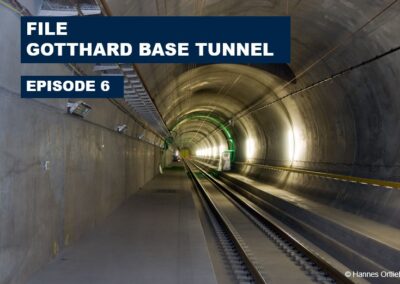
Gotthard Base Tunnel (#6): FOT pragmatically supports freight traffic
After the freight train accident in the Gotthard Base Tunnel, the Federal Office of Transport (FOT) is promoting rail freight transport with tangible measures: The tunnel may only be used for freight trains. The compensation per train operated in unaccompanied combined transport (UCT) will soon be increased to up to CHF 1,100. We, as the association of the shipping industry, would like to express our sincere appreciation for this. By the way: our voice also applies to foreign shippers.
This is what it’s all about:
- Gotthard base tunnel only open for rail freight traffic
- Higher compensation for transalpine UCT
- The VAP says thank you
Gotthard Base Tunnel open for freight trains only
Since the reopening of the east tunnel of the Gotthard base tunnel, it has been available exclusively for freight traffic. Around 100 train paths are possible every day. A further 30 trains per day run through the mountain section. This means that transalpine rail freight traffic has a total of 130 train paths at its disposal every day. By comparison: in 2022, an average of 120 trains crossed the base tunnel every day.
Thanks to this measure, the freight railways can handle rail freight traffic practically without restrictions. Admittedly, the routing over the mountain route is associated with considerable additional expense. But it mainly affects domestic traffic that is not dependent on the 4‑metre corridor.
Higher compensation for transalpine UCT
The FOT is committed to transalpine rail freight traffic and in particular transit traffic (see “The FOT strengthens rail freight traffic through the Alps”). The compensation per train operated in UCT will be increased by CHF 200 to up to CHF 1,100 in the coming weeks. The FOT also does not want to reduce the compensation per consignment for 2024, but will introduce a symbolic reduction of CHF 1 to CHF 57 per consignment. In this way, the FOT is supporting transalpine UCT in a very pragmatic way. Against the background of the difficult construction site situation on the access routes and the tense economic situation, the FOT is refraining from continuing on the current course to reduce compensation for UCT.
The VAP says thank you
The FOT deserves a big thank you for this pragmatic support. It strengthens the joint and targeted efforts of the entire industry to make the capacity restrictions on both the Gotthard and Lötschberg axes as bearable as possible. We see it as a sign of a common policy effort to support modal shift in transit traffic.
Train path price revision 2025–2028: Price increase is unfounded
The Federal Council plans to increase the train path price in freight transport from 2025. In detail, it wants to raise the basic price for wear and tear by almost 20%; on the grounds of uncovered weight-dependent marginal costs in this area. We reject this unjustified price increase. It accelerates the ongoing modal shift to the roads and contradicts the Federal Council’s modal shift objective.
This is the issue:
- Track access charges not derived transparently
- Traffic losses prohibit price increases
- Respect the legal principle of cost recovery and the polluter pays principle
- Incentive for low-wear freight wagons reversed
- Make infrastructure managers more accountable
Track access charges not derived transparently
The explanatory report of the Federal Office of Transport (FOT) of June 2023 is neither transparently designed nor comprehensibly justified. The reasons for the current determination of the train path price remain completely unclear. Since the FOT refers, among other things, to falling train path revenues, the impression is created that this is a hidden cross-financing of the SBB. Against the background of the “Sustainable Financing of SBB” bill and the reduction of the contribution margin in SBB passenger traffic envisaged therein, this justification is unreasonable for the representatives of freight traffic. Our negative response to the above-mentioned bill can be found in our hearing response of 7 March 2023 and in our blog post “SBB should take responsibility instead of 3 billion financial package”.
Traffic losses prohibit price increases
A price increase is unacceptable in view of the traffic losses in domestic, import, export and transit traffic and the significantly cheaper train path prices in the European environment. Shippers have been exposed to drastic price increases for years, especially in wagonload traffic. These are justified by exogenous factors such as train path prices.
Respect the legal principle of cost recovery and the polluter pays principle
The FOT justifies the price increase with the legal principle of cost recovery. This would be upheld even in the event of a price reduction in freight transport. On the contrary, a price reduction is in line with the polluter-pays principle, since freight traffic pays the standard marginal costs of an averagely developed network, which is mainly geared to the needs of passenger traffic. Shippers do not notice the efforts made by the infrastructure managers to build and maintain the infrastructure more cheaply.
Incentive for low-wear freight wagons twisted
The so-called wear factor is supposed to serve as an incentive to use low-wear rolling stock. In the meantime, the opposite is the case: the Federal Council is encouraging the industry not only to pay ever higher track access charges, but also to invest additional financial resources in low-wear rolling stock.
Holding infrastructure managers more accountable
The presented train-path price revision goes easy on the infrastructure operators. As representatives of the siding and terminal operators, who are directly affected by the planning, construction and maintenance costs of SBB Infrastructure in centralised sidings, we observe considerable inefficiencies and an almost shameless handling of financial resources. This is most likely equally true for the public network. The federal government should therefore also oblige infrastructure managers to contain costs.

EU aid: walking a tightrope between protecting the climate and distorting competition
In wagonload traffic (TWCI) within the European Union (EU), we are witnessing a development that is more political than market-oriented. The EU is promoting the transfer of freight transport to climate-friendly modes of transport such as rail and inland waterway with various programmes and funds, and in principle this is to be welcomed.
The public freight companies, supported by the unions, describe the TWCI as a «public service». However, it is not they who bear the consequences, but the States and shippers. In fact, the subsidies redistributed by the EU at taxpayers’ expense mean that the TWCI is heavily subsidised, with no incentive to increase productivity in the interests of sustainable development. This means that the TWCI is using taxpayers’, society’s and the economy’s money to cement a monopoly devoid of any public service obligations such as the obligation to carry or the obligation to publish tariffs.
This lack of market orientation and entrepreneurial spirit on the part of the public railways and the unions will not help to achieve either the traffic transfer objectives or the climate objectives. What’s more, as owners of the state-owned railways, governments are taking a long-term, imponderable financial and transport policy risk with regard to security of supply in their countries.
The consequences for shippers are no less serious. To achieve multimodal transport, shippers have to invest in the rail system, while they are dependent on a monopolistic company that is itself financially dependent and managed by political control. This is hardly security of supply and investment.
Subsidies must be used in a targeted and time-limited way to safeguard jobs in the long term and put TWCI on the road to success.
In this blog post, we take a close look at public subsidies in Germany, France, Austria and Switzerland from the perspective of their purpose and scale, and address the issue of conflicts of interest and the necessities involved.
What is at stake?
- State aid aims to establish sustainable and viable mobility.
- However, it can give rise to distortions of competition and discrimination.
- State financial aid must be used to ensure the transition to financial autonomy.
- Market players specifically need financial support for innovations such as DAC.
- The bodies granting the aid should check its effectiveness and any breaches of the rules on subsidies.
- If necessary, the law should be amended.
The European Commission provides financial support for the transfer of freight from road to more environmentally friendly modes of transport, such as inland waterways and rail. It provides financial aid in line with EU guidelines on State aid. The objective of this EU aid is sustainable and intelligent mobility, which in turn is supposed to help reduce CO2 emissions and relieve road congestion as part of the Green Pact for Europe. As is often the case with public funding, in the freight transport sector it is also necessary to ensure that competition in the internal market is not distorted and that self-financing and transparency are achieved.
Comparison of deficit financing in wagonload traffic
Country |
Subsidy programme and benefits |
Amount of subsidy |
Period |
| Germany |
Temporary, non-discriminatory and growth-oriented subsidy of operating costs (BK-EWV) This grant from the German Federal Ministry of Digital Affairs and Transport is intended as a transitional measure to increase the profitability of the TWCI through the deployment of digital automatic coupling (DAC). The Ministry’s aim is to support Federal and non-Federal railway undertakings in national and cross-border transport within the framework of a TWCI system description to be provided. Details of the BK-EWV programme are expected in July. |
80 million euros 100 million euros 100 million euros |
2023 2024 2025 |
| France |
Support for wagonload traffic transport services The purpose of direct subsidies is to compensate rail companies for the difference in cost between road and rail transport. The beneficiaries are rail companies active in the TWCI sector. |
450 million euros, i.e. 150 million euros per year |
2023–2025 |
| Austria |
«SGV-Plus» (TFM Plus) This subsidy programme helps rail transport companies to carry goods by rail that would otherwise have to be transported largely by road, by lorry. SGV-Plus consists of support for rail freight services and a subsidy for the infrastructure usage charge. Subsidies for connections and terminals The state helps companies to transport their goods sustainably by rail through measures such as these:
|
Approx. 90 million euros
13 million euros per year |
2023–2027
From 2023 onwards |
| Switzerland |
Improving the framework conditions for freight transport in Switzerland The Federal Council is planning subsidy programmes with the following benefits:
|
CHF 600 million, i.e. CHF 150 million per year |
2024–2027 |
Limited relevance of the comparison
The subsidies mentioned in the table above are expressed in absolute figures. This makes them difficult to compare, in the absence of a reference amount. For example, SNCF (France) achieves several times the number of tonne-kilometres travelled by SBB, but receives considerably less money in comparison. Unlike the countries of the European Union, in Switzerland the total amount of subsidies also includes the migration to DAC. It is precisely because most countries have numerous sources of funding at their disposal at the same time that it is extremely difficult to compare subsidies in a meaningful way.
Conflict of interest between climate protection and competition
Governments mainly use their subsidies to encourage the transfer of traffic to sustainable modes of transport. The ultimate objective entails the risk of distorting the competitiveness of rail freight. If rail freight is to remain viable not only ecologically, but also economically, those responsible must aim for an autonomous, market-oriented rail freight system that integrates all rail freight companies without discrimination on the basis of intramodal competition, and is a reliable partner for shippers. Switzerland has set itself the goal of self-financing, and is well on the way to achieving it.
Guaranteeing non-discrimination
Wherever public and private players in the market come together, the accusation of discrimination quickly arises. A classic example is last-mile subsidies. This is the subject of heated debate both internationally and in Switzerland (see RailBusiness no. 6 and 7/2023). In our blog article entitled «Outsourcing the last mile and making it non-discriminatory», we outline the form that a non-discriminatory last mile could take in Switzerland. We recommend that management of the system should no longer be entrusted to a single major operator – as is currently the case with SBB Cargo – and propose that instead, the first and last kilometre services should be provided by a single service provider. Ideally, this would be the infrastructure operator, which, apart from this, does not provide any transport services. In our blog article entitled «Subsidising wagonload traffic: preventing distortion of competition and discrimination», you will find a more detailed explanation of why non-discrimination is paramount when it comes to State aid.
In Germany, the Verband deutscher Verkehrsunternehmen (VDV) and Die Güterbahnen (The Freight Railways) are calling for non-discriminatory subsidies for service routes between the customer’s loading point and the last functional train consist. Appropriate regulations will ensure that the subsidy reaches particularly underserved and unprofitable regions, as well as new traffic, in order to attract rail transport to these areas as well.
Financial support for innovation
In our view, state funding should be a transitional measure designed to last until the players manage to finance themselves. This approach is particularly important for innovations such as the migration to DAC and the associated digitalisation of rail freight. Wagon owners cannot benefit directly from DAC, but have to make huge investments in re-equipping their rolling stock. To find out why we are in favour of up-front funding for the DAC, which paves the way for a new era of rail, rather than the ongoing subsidisation of an obsolete system, read our blog post entitled «Innovation in rail transport: DAC as a pioneer».
Rethinking the rail system
If the benefits of digitalisation are to be realised in rail freight transport, we need more than the DAC. What is needed is a fundamental transformation and optimisation of cross-system processes. Only in this way will market players be able to increase productivity, reduce costs and systematically adopt a customer focus in order to remain competitive by rail. This requires a new holistic approach to the entire rail system. This goes far beyond the (initial) financing of the TWCI or DAC. It concerns all the processes, incentive instruments, market mechanisms and interfaces of multimodal freight logistics in Switzerland.
Creating transparency through monitoring
If public funds are to be used in a targeted way, the objectives to be achieved with this support must be clearly defined. As is customary in the private sector, this means checking against measurable parameters, such as «how many DACs will be implemented by 2025 for how much money», «how many tracks have been built» or «how many lorry loads have been put on rail». The measurability of a success rate enables the players involved to adapt their strategy accordingly.
Preventing abuses of EU state aid guidelines
In 2020, Deutsche Bahn was accused of massive market distortion, as it was to receive a €5 billion increase in equity from the state as a result of the COVID-19 crisis. At the beginning of 2023, the European Commission launched an investigation into possible illegal state aid of between ten and twenty billion euros paid to the Freight sector of the state-owned railway company SNCF. These recent examples show that public aid always carries a risk of abuse. It is all the more important for governments to create the same conditions of competition for all and, if necessary, to refine the legal framework a posteriori.[1]
Refining the guidelines a posteriori
The European guidelines for the rail sector are an example of such a review. The European Commission has proposed revising them in order to shift traffic to more sustainable and less polluting solutions while maintaining a level playing field within the European Union. The consultation of Member States on the promotion of transparent and non-discriminatory programmes, the limitation of individual aid to exceptional cases and the modification of the aid ceiling ended on 16 March 2022. The majority of respondents favoured the promotion of programmes offering equal opportunities to all companies and the granting of individual aid only in exceptional cases. The European Commission plans to approve the revision of the State aid guidelines applicable to the rail transport sector in the 4th quarter of 2023.
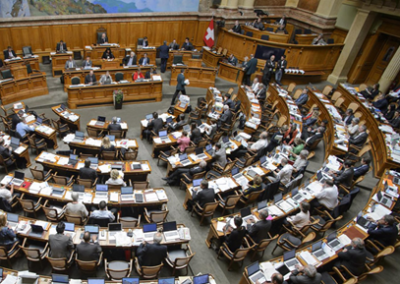
Transport policy decisions of the summer session 2023
In the summer session from 30 May to 16 June 2023, various sector-relevant business was discussed. The results are largely in line with our expectations. However, we regret the missed opportunity to link the proposal for the agglomeration programme with the expansion of the national road network in order to further develop projects and transport modes as an overall system.
That’s what it’s all about:
- More financial means for the rolling road (Rola), we demand quality control.
- Yes to simplified approval of rolling stock for international rail traffic
- Yes to modernisation and expansion of the Swiss national road network
- Yes to the Agglomeration Transport Programme – regrettably without a link to the expansion of the national road network
- Interpellation on the renationalisation of SBB Cargo
Accompanied combined transport (Rolling Road, Rola):
On 1.6.2023, the Council of States dealt with the Federal Council’s dispatch of 30 September 2022 on the amendment of the Freight Traffic Transfer Act and on a federal resolution on a payment framework for the promotion of accompanied combined transport (Federal Council business 22.064). Following the National Council, the Council of States has now also decided to support the “Rolling Highway” (Rola) until the end of 2028 instead of only until 2026 as proposed by the Federal Council. The Confederation can provide a total of CHF 106 million for this support between 2024 and 2028.
With regard to the 2023 modal shift report, the VAP recalls its still outstanding demands:
- Technology-neutral promotion of transports, especially in selected regions with volume potential.
- Quality control also for conventional transports
We consider the one-sided promotion and quality control only in UCT as a missed opportunity. The potential of conventional transport should also be fully exploited – with appropriate application of the modal shift measures, i.e. financial support and quality control.
Amendment of the Railway Act within the framework of the 4th EU Railway Package:
On 13.6.23, the Council of States approved bill 23.024, according to which the European Railway Agency (ERA) is to be responsible for the approval of rolling stock in international rail traffic. Railway companies should no longer have to go through separate approval procedures when introducing new trains in several countries. The Federal Council is now seeking the permanent adoption of this EU solution, which will require an amendment to the overland transport agreement with the EU. The business will now be submitted to the National Council. The VAP supported this draft amendment (see blog article: Revision of the railways act guarantees access to the EU railway network), as it allows for further steps towards harmonisation of regulations in railway operations and facilitates the adoption of this package in the land transport agreement.
Payment framework for national roads 2024–2027 and expansion step 2023:
The Federal Council is planning to modernise and expand the Swiss national roads network with a budget of around CHF 12 billion. Of this, around CHF 8 billion is earmarked for operation and maintenance, while CHF 4 billion is to be allocated to special expansion projects. We at the VAP support this bill and emphasise the importance of a sustainable transport infrastructure for multimodality and modal shift. On 30.5.2023, the National Council decided to allocate as much as CHF 5.3 billion to expansion projects instead of the CHF 4.4 billion requested by the Federal Council. In addition to the five projects included in the federal decree, the National Council considers the extension of the A1 on Lake Geneva to be equally urgent. The Council of States will vote on the bill next.
Commitment credits for agglomeration transport from 2024:
The National Council approved contributions of over CHF 1.6 billion for the new agglomeration transport programmes. A slight increase was made for the Moscia-Acapulco road tunnel in Ticino. We support this federal decision, which is intended to promote transport infrastructure projects in Switzerland’s conurbations in order to create a more efficient and sustainable transport system.
Regrettably, however, NR Wasserfallen’s minority motion was rejected. This called for the bill on the proposal for the agglomeration programme with the expansion of the national road network in order to consider projects and transport modes as an overall system. This should prevent projects and modes of transport from being played off against each other. We consider this a missed opportunity. In the event of a referendum, we will oppose it, in the interest of the country’s security of supply.
See also our commentary on LinkedIn: Billions approved for agglomeration transport programmes: National Council misses chance for holistic transport system
SBB Cargo back in the lap of the state: What’s the point?
With his interpellation «SBB Cargo zurück im Schoss des Staates. Was soll das?» (SBB Cargo back in the lap of the state. What’s the point?), NR Christian Wasserfallen FDP/BE is asking the Federal Council for an assessment of the SBB Group’s decision to take over 100% of the share capital of SBB Cargo and to place SBB Cargo directly under the management of the Group. This unilateral change in the market and power structure is detrimental to the portents of the pending reform of the framework conditions for Swiss freight transport. The VAP welcomes the questions put to the Federal Council.
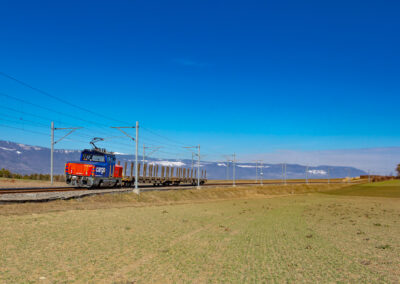
SBB Cargo again a fully-owned subsidiary of SBB
Integration – a rejection of market orientation?
SBB Cargo loses both its logistics experience in the shareholder body and on the Board of Directors, as well as the external chairmanship of the Board of Directors as a symbol of entrepreneurial freedom. Stigmatised as unsuccessful, it is back at the board table. What can customers and relocation politicians expect?
Here’s what it’s all about:
- Logistics companies Planzer, Camion Transport, Galliker and Bertschi give back minority stake
- SBB Cargo to be fully reintegrated into SBB Management Board
- External chairmanship of the Board of Directors and decision-making powers of SBB Cargo to be abolished
- No sign of necessary reorganisation of wagonload traffic
- Compensation and interpretation as public service
- Traffic losses continue
SBB remains true to itself. The integrated railway separates itself from the minority shareholders in its freight railway SBB Cargo and fully reintegrates them into the group management and its railway family. And the boss, Ms Baer, is replaced by a real estate expert. The reasons for these steps are not explained.
Likewise, it remains unexplained why the WLV cannot be run on its own merits and should continue to be supported with taxpayers’ money in the long term. The only thing that is clear is that wagonload traffic is to be transformed into a public service with compensation and that, with “Suisse Cargo Logistics” and the newly founded SBB Intermodal AG, combined transport is also to be taken over by SBB and strategically withdrawn from the market. It is imperative to raise some questions here, such as non-discriminatory and fair conditions for all players.
The resurrection of SBB Cargo as a relic before OBI Organisation of Railway Infrastructure 16.075 probably comes as a surprise not only to the VAP, as a representative of the shipping industry. It is unclear what role politics, DETEC as owner, on-lender of taxpayers’ money and supervisory authority played in this decision.
We at the VAP are analysing and taking soundings for the time being. We are seeking dialogue with politicians, DETEC, SBB and the new CEO of SBB Cargo. Based on these findings and hopefully a satisfactory factual situation, we will determine our further course of action and inform you again about this current status.
Values such as competition, market orientation, innovation, non-discrimination, productive modes of transport and self-sufficiency are part of the DNA of the VAP. And ultimately, our “old” ideas such as “branch railways” and a spin-off of the first/last mile service could be the right answer for a strong rail freight system in Switzerland.
Looking back at the year 2018, SRF report: Discussion about freight traffic – SBB Cargo off track (in german)
Agenda for the summer session 2023
In the summer session from 30 May to 16 June 2023, a number of industry-relevant agenda items are on the agenda. Here is a brief overview with our critical appraisal.
This is what it’s all about:
- More financial resources for the rolling road (Rola).
- Yes to simplified approval of rolling stock for international rail traffic
- Yes to modernisation and expansion of the Swiss national road network
- Yes to the agglomeration transport programme – in step with the national roads
Accompanied combined transport (Rolling Road, Rola)
After the National Council, the Council of States is now dealing with the Federal Council’s dispatch of 30 September 2022 on the amendment of the Freight Shift Act and on a federal decree on a payment framework for the promotion of accompanied combined transport (Federal Council business 22.064). Our assessment: There is a lack of technology-neutral promotion of transport, especially also in selected regions with volume potential. Quality control should also be extended to conventional transport. The extension of the RoMo until 2026 in accordance with the BR proposal is undisputed and expedient.
23.024 Railways Act. Amendment (implementation of the technical pillar of the 4th EU railway package)
The Federal Council aims to strengthen cross-border rail transport and plans to simplify the approval of rolling stock for international journeys. An important step in this direction is the introduction of uniform European approval procedures for new rolling stock. Following a positive response in the consultation process, the Federal Council decided in its meeting on 22 February 2023 to amend the Railway Act to create the necessary basis for this. The VAP supports the draft amendment (see blog article: Revision of the Railways Act secures access to the EU rail network), as it enables further steps to be taken to harmonise regulations in the area of rail operations and facilitates the incorporation of this package into the overland transport agreement.
23.032 National Roads Payment Framework 2024–2027, 2023 Expansion Plan for National Roads, Commitment Credit and Amendment to the Federal Decree on the National Roads Network
The Federal Council plans to modernise and expand the Swiss national roads network with a budget of around CHF 12 billion. The expansion is intended to relieve traffic congestion and improve road safety. About 8 billion francs are earmarked for operation and maintenance, while 4 billion francs are to be allocated to targeted expansion projects. These investments are important because the national roads account for a high proportion of the traffic volume. The VAP Association of Shippers supports the bill and emphasises the importance of a sustainable transport infrastructure for multimodality and modal shift. A rejection would mean a relapse into playing off road against rail in past times.
23.033 Federal Decree on the Commitment Credits from 2024 for Contributions to Measures under the Agglomeration Transport Programme
The VAP Association of the Freight Transport Industry supports the federal decree on commitment credits within the framework of the agglomeration transport programme. With a total sum of around 1.5 billion Swiss francs, transport infrastructure projects in Swiss conurbations will be supported in order to create a more efficient and sustainable transport system. These measures contribute to traffic calming, increased safety and improved quality of life in urban centres and at the same time increase their attractiveness as business locations.
However, the VAP Association of Shippers emphasises the need for the bill to enter into force in parallel with the planned expansion of the national road network, as proposed by the Wasserfallen minority. Investment in the national roads is crucial to calm traffic in the centres while providing sufficient capacity in the periphery. In view of this, we recommend that the bill be adopted.

Status quo DAK: between wish and reality
We have supported the digital automatic coupler (DAK) since its beginnings. That is why we are involved in the international umbrella organisation of wagon keepers UIP, the European DAC Delivery Programme (EDDP) and the Swiss DAK migration project. However, much remains to be done at all levels. Here is an interim update on technical and market developments.
Here’s what it’s all about:
- Technology still raises questions
- Fair cost-benefit transfer sought
- Rising transport prices can bring about a shift back to the roads
- Cooperation with Europe: a must
- DAK as basis for fundamental system change
Together with the Federal Office of Transport (FOT), SBB Cargo and the Association of Public Transport (VöV), we at the VAP are driving the Swiss DAK project forward. Initial findings from this cooperation were recorded in the concept report “Automation in rail freight transport in Switzerland, starting with the migration to digital automatic coupling” of 24 October 2022. They were also incorporated into the current consultation draft on the future of Swiss freight transport and – with some additions – into the dispatch that the Federal Council is preparing for parliament in summer 2023. Numerous workshops and bilateral discussions with the rail freight sector have given rise to questions, criticisms and possible solutions that now need to be explored in greater depth.
The technology raises questions
Defining the coupling head was a first milestone. Now it is time to develop and test the digital elements. Two technical approaches are being pursued for this. With “Powerline-Plus”, the electrical impulses and data are transmitted over the same line with a limited number of contacts. In Switzerland, a consortium of experts will be testing this approach in the coming months. In the “Single Pair Ethernet” (SPE) model, on the other hand, separate lines are needed for power and data transmission.
Questions such as these remain open with both technical approaches:
- Under what weather and climatic conditions is reliable operation possible?
- Are there downtimes in data transmission during the numerous operational processes (shunting, travel (tight radii, inclines …)?
- Finally, what functionalities does the digital component contain?
- How will the upward compatibility be designed, especially from DAK4 to DAK5?
- How will the Europe-wide compatibility of the future DAK rolling stock be ensured?
- Currently, the European railway sector has only a few experts on this topic, which is a great challenge. There is also a need for clarification on mechanical aspects such as the force effects of the new coupling on the individual wagon types or the installation of the DAK in locomotives due to weight and/or space problems or the safe integration into the vehicle control technology. Questions like these must be answered by 2026.
Cost-benefit transfer can bring about a reverse shift
Investments in DAK migration are considerable, especially for vehicle owners. We assume costs of CHF 20,000 to CHF 40,000 for wagons (depending on wagon type) and CHF 60,000 to CHF 250,000 for locomotives. However, positive effects for the vehicle owners will only become noticeable after complete migration, i.e. after ten years at the earliest. This means that costs will rise in the first few years without additional revenue, which will lead to higher prices for wagon hire. The railway undertakings (RUs) will also have additional expenses during the migration phase of several years due to parallel operation. High price sensitivity could cause a shift back to the roads. We already noticed this effect in 2023 with the passed-on price increases due to increased traction current costs.
We at the VAP are looking for solutions to these challenges:
- How can the RUs, as the main winners of the DAK, pass on the efficiency gains and cost savings to the vehicle owners? In monopoly-like structures such as single wagonload traffic, market-based mechanisms do not work.
- How high do subsidies (A‑fonds-perdu contributions, loans, funds) have to be in order to compensate for the unequal cost-benefit transfer, and how can a major shift back to the road during migration be prevented? What happens if subsidies or subsequent financing to the state-owned RUs are almost completely discontinued with the DAK?
Investing in new rolling stock is certainly conceivable or even necessary for many wagon owners. But the real question is how existing fleets can be efficiently converted. In doing so, it is important to take the following aspects into account without disadvantaging players through no fault of their own:
- Even with newer rolling stock, there are difficulties in retrofitting a DAK.
- The purchase of new cars has become 50 percent more expensive due to increased raw material prices.
- The production of new cars with DAK has to be started after the specifications have been finalised. The number of units is limited at the beginning depending on the type of wagon.
- Older rolling stock with a simple conversion causes lower additional costs.
- Different vehicle owners own identical types. The conversion of the type vehicle must be independent of the keeper and the high one-off costs must be covered.
Track to track with Europe
The majority of those involved agree: only in close cooperation with Europe can we master sustainable migration. The technical and operational challenges of conversion are similar on both sides of the border. Questions about the conversion process up to successful implementation and financing can only be answered if all experts and decision-makers are at the table. Unfortunately, that is only a handful.
Our contribution from Switzerland is to deal with the national circumstances and to prepare the groundwork well. This includes launching pilot transports; the first DAK test trains have been running in Switzerland since April 2023. We should gather this experience and incorporate it into the pan-European project.
We would like to show that efficient and sustainable innovation at European level is only possible together, using the following examples:
- Coordinate workshop capacities: Coordination between the countries and wagon keepers must be ensured in order to have the wagons to be converted in operation (national and international relations) routed to the nearest or best possible workshop and returned again.
- Align funding requirements. The prerequisite for funding is usually an entry in the vehicle register and/or a registered office in the respective country. However, as wagons are not always used in that country but move throughout Europe, funding must be secured for wagon keepers in all countries at the time of migration.
- Coordinate migration timetable. Early migration leads to new interfaces in rail freight transport. Specifically, a wagon converted and funded in Switzerland cannot run in Germany as long as the DAK migration has not started there and the corresponding import and export transports have not been coordinated. In addition, the vehicle owner can only use his fixed assets to a limited extent.
- Bring decision-making bodies together: The technical solutions are adopted in the specified bodies of the EU and then adopted by Switzerland. Integrating these resources into the EU project would be more expedient than having Switzerland set up its own organisation.
In order to contribute to the overall realisation at EU level, we in Switzerland must concentrate on the preparatory work with all the companies concerned and actively push ahead with our test phases and pilot transports. We cannot afford any teething troubles with the products and specifications.
Basis for a fundamental system change
The DAK is not a technical undertaking, but the beginning of the necessary digitalisation and integration of rail freight transport into a sustainable logistics chain. With the DAK, elements such as automatic brake testing, automatic recording of the wagon sequence, train integrity control or electro-pneumatic braking are added in addition to the coupling process.
In order for the DAK to unfold its full technical effect and give rail freight transport the necessary market dynamics, we have to work on the following aspects before the start of migration:
- Redefine operational processes
- Adapt regulatory requirements and regulations and simplify timeframes
- Prepare and adapt infrastructure and sidings
- Train affected groups for migration and operation
- Automate inspections and maintenance
- Automate transport information for shippers
- Effectively protect digital data from unauthorised access
We at the VAP also aim to launch a data platform and exchange data in the sense of an eco-data system. We are convinced that the DAK will only bring the necessary and large-scale added value to the railway sector with the exchange of data. We are therefore very pleased that despite initial scepticism from the sector, the FOT has taken up this aspect. It also intends to include freight transport in the planned Mobility Data Infrastructure (MODIG). In our next blog on the DAK, you can read about the extent to which the DAK contributes to an innovative, self-sufficient and customer-oriented rail freight transport system and how the letter K can therefore be translated primarily as connectivity.

Dr Peter Füglistaler: “In principle, I welcome new market participants seizing their opportunity.”
The Federal Office of Transport (FOT) promotes the sustainable development of freight transport and the efficient interaction of all modes of transport within the framework of Swiss policy. It is responsible for licensing, financing and safety supervision in rail transport, cableways and chairlifts, buses and shipping. Thanks to favourable framework conditions, it should be possible to operate rail freight services on a self-financing basis. In addition, the federal government can grant investment contributions for technical innovations in rail freight transport. The FOT controls and checks the subsidy payments in freight transport within the framework of a controlling system. Dr Peter Füglistaler has been Director of the FOT since 2010. Before joining the FOT, Peter Füglistaler held various positions at the Swiss Federal Railways (SBB). In an interview with the VAP he answers questions about rail freight transport.
VAP: Mr Füglistaler, SBB Cargo does not seem to be coming out of restructuring/subsidy mode. At the same time, federal finances are very tight. Can rail freight customers sleep easy, will SBB Cargo be able to turn the corner?
Dr Peter Füglistaler: The Confederation has made it clear that it wants to develop freight transport further – taking into account energy and climate policy goals and in the knowledge of the great importance of rail transport for Switzerland’s security of supply. The Federal Council is also prepared to modernise rail freight transport technically and organisationally and proposes targeted financial support for this purpose. Nevertheless, it is important that shippers also play their part in shaping the future.
The sugar beet contract was lost, Coop successfully runs its own RU, now also in the WLV system. Gravel companies are building up their own EVU. How do you assess this market development from the owner’s point of view?
I can only speak here as the director of the financing and supervisory authority. In principle, I welcome it when the market plays and new market participants seize their opportunity. SBB Cargo, for example, also has to assert itself in the market and look at its own economic viability.
The pressure to settle, keyword “Major Accidents Ordinance”, has an impact on the transport of dangerous goods. What is the FOT doing to ensure that dangerous goods transports continue to be possible within the existing framework in order to secure self-sufficiency and safeguard Switzerland as an industrial location?
The FOT regularly reviews the risks of dangerous goods transports and, if necessary, implements measures at an early stage in dialogue with the parties involved. A good example is the joint declaration by industry, transport companies and authorities on risk reduction in the transport of chlorine. Such early recognition and joint action makes it possible to continue transporting dangerous goods safely by rail.
While Europe focuses on the DAK, SBB is more interested in the AK – without the D. Is this also your perception and would you support this position of SBB?
I don’t see this separation at SBB at all. Like BAV, VAP and VöV, SBB is of the opinion that digital functions are needed to make rail freight transport safer, faster, more flexible and thus more reliable and cheaper. With the support of the FOT, SBB Cargo has set up a test train to test and optimise the power supply and data transmission in goods trains. The results are being incorporated into the work at European level, where SBB is actively involved, as are all the other railways in Europe. Switzerland will not be making any extra moves as far as digital automatic coupling is concerned. However, we will not be able to wait if the work in Europe is delayed. Because by waiting, we risk the achievement of nationwide rail freight transport. As soon as the technical specifications in the TSI standards are fixed, we want to start.
There are many calls for the industry to speak with one language. Now the industry has jointly realised the “Vision 2050”, but unfortunately this was not reflected in the design of the consultation for nationwide rail freight transport. Was the voice too quiet? What is the FOT’s expectation?
The vision was drawn up by the FOT’s accompanying group for the further development of freight transport by rail. The most important associations and players in Swiss rail freight transport are represented there. But the thing is: despite this vision, the associations have expressed very heterogeneous ideas and in some cases not very realistic wish lists for the future of Swiss rail freight transport as part of their statements on the consultation process.
How would you describe the VAP?
The VAP is an important voice in the Swiss freight transport industry, which in turn is existential for the country’s security of supply.
What strengths do you attribute to the VAP?
The VAP has its strengths in bundling the interests of the players and in its good relations with the political decision-makers.
What else would you like to see from the VAP?
In the future it will be important to present the interests of the shipping industry even more pointedly to the outside world. The VAP can strengthen its position in this respect.
To whom would you recommend cooperation with the VAP?
Rail freight transport does not work without sidings and freight wagons. That is why cooperation with the VAP is recommended to everyone who wants to operate rail freight transport successfully.
Dr Füglistaler, thank you for the interesting interview.