
SUSTAINABILITY
The VAP understands sustainability as the three aspects of ecological production, social working conditions and a sustainable economy. Only if sustainable solutions are found is the future secure.
Sustainable production
One third of emissions are due to transport. We have set ourselves high goals to reduce these emissions. Rail transport is already a very environmentally friendly means of transport.
Sustainable working conditions
The safety and health of shunting workers is strained by the cumbersome procedures and heavy physical work. In the foreseeable future, there will be a shortage of workers in this sector due to the unattractive nature of the work. We can change this and take on social responsibility.
- With the Digital Automatic Coupling (DAC), the risk to health and safety is significantly reduced.
Sustainable economy
Only a system that makes a profit can survive in the long term. In order to remain competitive, the rail freight sector must make its processes more efficient, increase its productivity and make better use of its capacities. This is important, among other things, in order to be better able to absorb the forecast growth of 30% more freight traffic volume by 2050.
- With the automation and digitalisation of rail freight transport, there is a sustainable push that increases the marketability of the railway and also reduces production costs.
Noise reduction and automation make rail more attractive
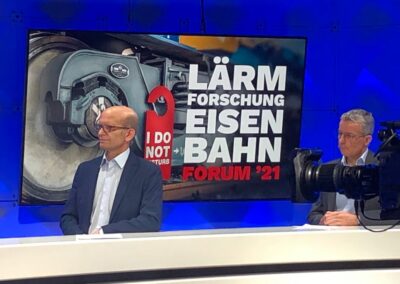
A considerable potential for more sustainability in rail freight transport lies in noise abatement. Noise must be further reduced so that an increase in rail freight transport can be realised without significant increases in noise. This will then benefit the environment and the population. The speakers at the Noise Research Forum 2021 explained which concepts and measures are currently being examined and are promising.
At the Noise Research Forum 2021, the focus was on an essential aspect of future-proof rail freight transport: automation. For rail to become more attractive for freight transport, it must become more efficient and sustainable. One example of this is the digital automatic coupler (DAK). It represents a major milestone in automation and allows for a considerable increase in efficiency in European rail freight transport. If rail freight transport becomes more cost-effective, the share of rail in the total volume of traffic can increase, which favours CO2 reduction.
The management of infrastructure and traffic must also be increasingly automated and digitalised. Real-time information for customers on the transport or safe operation of the wagons used and the correct loading as well as semi-autonomous operation of the sidings strengthen rail freight transport. Start-up financing would facilitate the digital transformation, while at the same time subsidies could be reduced.
The VAP makes a significant contribution to strengthening the innovative strength and the will to transform of its members. Only in this way can rail freight transport become more attractive and develop into a valid alternative to the road. To this end, the VAP supports its members in the implementation of automation in Switzerland, always in coordination with developments and requirements in Europe.
Detailed information from the Railway Noise Research Forum 2021
Rudolf Sperlich, Vice-Director of the Federal Office of Transport (FOT), welcomed the participants and looked back on the development of noise remediation to classify the forum. He explained Switzerland’s pioneering role in Europe and noted that the programme had been implemented very successfully in terms of costs and deadlines. However, because the effect fell just short of the statutory remediation target, the parliament unanimously adopted additional measures in 2013. Innovation assistance and departmental research are two of these supplementary instruments that will expire in 2025. For this reason, a wealth of ideas, networking and the will to innovate are once again called for in order to help the new, interesting approaches to success or to broad application.
Paul Steffen, Vice Director at the Federal Office for the Environment (FOEN), pointed out in his welcome address the need for further innovations in the railways. Innovation is still necessary, not only for the health of residents, but also to strengthen the environmental advantage of rail over road and thus to maintain market share in freight transport.
Detlef Schlickelmann, representative of the VAP Swiss Rail Shippers Association, explained that the noise remediation project ended in 2016 with the commissioning of the last 4,000 or so refurbished wagons. The industry had successfully organised the entire process of series engineering, approval, conversion incl. material pool and financing under the project management of the VAP. Schlickelmann added that the digital automatic coupler (DAK) project would create a great increase in efficiency in European rail freight transport and that the VAP wanted to write a second success story for the progress of rail freight transport with the rapid implementation of the DAK project.
Railway noise research according to the Federal Railway Noise Abatement Act (BGLE)
Fredy Fischer, Deputy Head of the Noise and NIR Division at the FOEN, emphasised in his introductory presentation how important it is for the railways to become even quieter. He called on the industry representatives to create a common vision of the quiet railway. If this required research or development, he said, the federal government would be happy to support projects.
5L demonstrator train
Jens-Erik Galdiks, head of fleet technology at SBB Cargo, used the “5L demonstrator train” project to show that current technologies can reduce the noise of freight wagons by a further 6 dB. Here, it is important to keep an eye on and consider the cost-benefit ratio. Other effects such as wear reduction are also significant. These commercial effects do not necessarily accrue to the investor. Therefore, a balance of benefits between infrastructure managers, railway undertakings and wagon keepers must be created. Jens-Erik Galdiks further stated that a further noise reduction of freight wagons would be disproportionate at present and that other measures such as optimisation of locomotives should be pursued.
Overall optimised innovative freight wagon
Dr Hanno Schell, Head of Innovation at VTG Rail Europe GmbH, spoke about the goal of designing a quieter freight wagon. The first step was to reduce the weight by 800 kg and the sound from 83 dB(A) to 76 dB(A). VTG further developed the bogie of the type RC25NT-H‑D from the company ELH Eisenbahnlaufwerke Halle GmbH & Co. KG further. It replaced the friction damping with hydraulic damping. This enabled it to save 200 kg per bogie in the cross beam at the drawbar. VTG also installed Bonatrans wheelsets with a noise-reducing BASF coating. A welded steel disc was used for the disc brake, which is 49 kg lighter than conventional cast discs; a further 13 kg could be saved on the disc brake caliper. Various tests have already been carried out in Switzerland with the quieter bogie. All in all, it would allow higher driving speeds, take more weight and, thanks to the hydraulic damping, have very good running characteristics.
Composite wheelset
Professor Masoud Motavalli, head of the Structural Engineering Department at the Swiss Federal Laboratories for Materials Testing and Research (Empa), spoke about the use of lightweight and high-strength fibre-reinforced plastics to produce a composite wheelset and a composite bogie. A feasibility study showed that the designed wheelset was 40% lighter than the conventional metal version. In addition, a noise reduction of 3 dB was achieved. The carbon fibre-reinforced plastics are corrosion-resistant, have a very long service life and high fatigue strength, but are much more expensive compared to classic materials. Masoud Motavalli therefore proposes to design an entire bogie out of composites, because this would make optimised pricing more feasible. He is convinced that a massive weight reduction would be possible and the self-damping of the material would reduce the number of dampers. In addition, other innovations could be incorporated, for example self-steering, which would reduce the wear and tear on the tracks. All this would bring a significant noise reduction compared to conventional bogies.
Development of a superstructure simulation tool
In his presentation, Jean Marc Wunderli, Head of the Acoustics/Noise Reduction Department at Empa, presented a numerical model for the simulation of rollover processes, which simulates the resulting contact forces, the structural vibrations and finally the radiated airborne sound in three modules. Mr Wunderli emphasised that simulation tools that modelled the sound generation and radiation of the rolling noise of railways in a physically correct manner were a mandatory prerequisite for optimisations to the vehicle and superstructure. Due to the high complexity of the system and the partly contradictory requirements (noise, vibrations, wear, positional stability …), a trial-and-error approach was not expedient.
“Rail pads – less rolling noise and more protection
Holger Frauenrath, professor at the Institute of Materials Science at the Ecole Polytechnique Fédérale de Lausanne (EPFL), presented a project to develop new types of rail pads. These should enable both better protection of the railway superstructure and a noise reduction of at least 1 dB (A) compared to conventional rail pads. The multidisciplinary project team brings together researchers from EPFL, HEIG Yverdon and Empa from the fields of materials science, numerical simulation, vibroacoustics, environmental engineers and railway experts from SBB. Based on an experimental modelling chain ranging from the material properties to the behaviour of a rail pad as a component to the system behaviour in the track, new multi-material rail pads with a soft core with high damping capacity between 200 and 2’000 Hz are developed. These will be optimised for a good balance between mechanical stability, noise reduction and permanent way protection. Designs are currently being tested to European standards and prepared for the final development phase, which will involve the production of engineering-scale prototypes for field trials in the track from March 2022. The new rail pads will be of interest both for reduced noise pollution in densely populated countries and for railway operators, as they should reduce the costs of maintaining the permanent way.
Optimised concrete sleeper, optimised intermediate layer
Dr Christian Czolbe, Senior Engineer Acoustics at PROSE AG, showed that noise along railway lines depends on both the rolling stock and the components in the track. For the infrastructure, it therefore makes sense to take measures that increase rail damping and reduce rail noise. In a research project, PROSE developed acoustically optimised concrete sleepers together with Vigier Rail and examined two promising prototypes in a test track. In another project, an inconspicuous and barely visible component between rail and sleeper was optimised. Dr. Christian Czolbe stated that the developed Bategu intermediate layer unites a longstanding demand of the railway industry: it dampens the dynamic impact loads in the superstructure and reduces noise at the same time. With a measured noise reduction of up to 5 dB (A), it would be significantly quieter along the line, which residents could perceive and confirm immediately after its installation. It also protects the track superstructure and thus leads to a reduction in life cycle costs – a win-win situation for the railway industry and residents. The new Bategu intermediate layer has passed all relevant standard and field tests as well as the fatigue strength tests and is now available for safe series use in the railway infrastructure.
Measurement of acoustic roughness
Florian Mauz, research associate and doctoral student at ETH Zurich, presented a development approach for an optical measuring device for measuring acoustic roughness on rails. In the future, it should be possible to measure the roughness from the moving train. By cleverly combining several sensors, the measurement result could be optimised. Florian Mauz showed the test setup and the series of tests in a laboratory environment. Soon the approach would be tested on a moving train and validated for its accuracy.
The link to the Forum’s website is www.laermforschung-eisenbahn.ch.
Further information on the departmental railway research and the award criteria can be found on the FOEN website (in german, french or italian).

Motion CO2-free rail freight transport
The motion 20.3222 «Rail freight transport and contribution to reducing CO2 emissions» submitted by VAP President and Councillor of States Josef Dittli was adopted by both Councils. The aim is to draw up a plan of measures that outlines how rail freight transport and multimodal logistics solutions can make a better contribution to reducing CO2 emissions. In the action plan, technical, operational, infrastructural, legal and financial options are to be identified, evaluated and put together into a promising package of measures. The cantons, railways, logistics service providers and shippers are to be involved in the work of the federal administration.
Harnessing the sustainability of rail freight
With the Green Deal, the European Union aims to become climate-neutral by 2050. On 28 August 2019, the Federal Council aligned Swiss greenhouse gas targets with this. As a consequence, the transport sector must reduce CO2 emissions by 90%. Freight rail is an essential part of the solution towards CO2 neutrality. For example, SBB Cargo uses hybrid locomotives on the last mile. Trains use 90% hydropower for their propulsion, and from 2025 it will be 100% renewable energy. Rail freight should therefore take up a higher share of transports. In transport logistics, there is a trend towards smaller consignment sizes, shorter transit times and higher punctuality requirements. Only a multimodal logistics chain with the freight railway as a strong link can do justice to this package of tasks. Here, logistics service providers bundle the goods or packages for the railway and synchronise them with the timetable. Promoting multimodal logistics solutions in all combination forms of rail, road, Rhine favours energy-efficient and CO2-optimised transport solutions and relieves the environment in social, ecological as well as economic terms. The federal government should support this multimodality with suitable measures.
Not a new concern
SR Dittli had already submitted a similar interpellation in March 2019 (19.3148 «CO2-free rail freight transport and Energy Strategy 2050»), which suggested a reduction in the train path price in connection with the train path price revision as of January 2021 to promote sustainable rail freight transport. In December 2019, several motions with identical wording followed in parliament calling for a support package for public transport based on its sustainability. This new motion is now intended to trigger a strategy definition geared towards passenger and freight transport in order to prevent a further expansion of passenger transport at the expense of freight transport capacities on the network. Above all, however, the remaining legal, operational and technical hurdles in the road/rail interface that hinder multimodal logistics solutions are to be removed as far as possible.