
INNOVATION
What innovations are moving rail freight transport? The VAP promotes the automation of rail freight transport and is represented in the project management of the migration of the DAC (digital automatic coupling).
Thanks to the DAC, rail freight transport is becoming more efficient, more productive and empowered to integrate into the multimodal logistics chains of the economy. With his motion 20.3221 “Transporting goods by rail more efficiently through automation”, VAP President and Councillor of States Josef Dittli provided the impetus for an implementation and financing concept for the automation and digitalisation of rail freight transport. Together with the Federal Office of Transport (FOT) and the Association of Public Transport (VÖV), the VAP has signed a declaration of intent for the digitalisation and automation of Swiss rail freight transport. Numerous companies in the sector have also declared their cooperation.
- Absichtserklärung zur Automatisierung im Schienengüterverkehr der Schweiz 2021
- Gemeinsame Absichtserklärung von CFS, VöV und BAV zur Innovationsförderung 2017
Media report:
Report by Zeit Online of 26.10.2021:

Data platforms: Better cooperation, more competition
In the Year of Rail 2021, we are focusing our attention on the development of so-called data platforms in Germany. A first neutral data platform for combined transport is to go live as early as 2022. All players in combined transport are to be involved. The project is supported by the German Federal Ministry of Transport and Digital Infrastructure (BMVI).
Aiming for opening to all providers
Under the aegis of the Association of German Transport Companies (VDV), a comparable platform for wagonload transport is currently being set up. The VDV has the support of the German Chemical Industry Association (VCI) for this project. In view of the developments in wagonload traffic in Germany, the VCI, too, no longer seems convinced of the performance of the largest provider. Just like us, the VCI does not seek subsidies, but sees the solution in opening the marshalling yards and nodal stations to all providers. This is the only way to make stronger competition possible in wagonload traffic as well. With a neutral data platform, a network open to the market could be utilised much better and faster.
Goodbye to narrow-minded thinking
The separation of rail transport into combined transport and conventional transport has never really been comprehensible. Garden-variety thinking is counterproductive and complicates the overall system. Separate booking platforms are an indication that the focus is not on an overall system with an overall benefit for the entire rail freight industry. Sustainable, competitive and end-customer-oriented (rail) freight transport can only be achieved through the interaction of all players.
That is why we are working intensively on the idea of a platform for rail freight transport. In this context, we are in close contact with the VDV and its partner companies for a platform for cross-border combined transport. Because we are convinced that only platforms that are compatible across Europe will be successful.
Progress for automation in rail freight transport
The Councils adopted the motion «Transporting more efficiently by rail through automation» by VAP President and Councillor of States Josef Dittli in the autumn or winter session 2020. The Europe-wide introduction of digital automatic coupling, automatic train preparation and other digital platforms is a main priority. By 2022, the member states want to agree on a pan-European implementation strategy.
Automation of the last mile
VAP President and Member of the Council of States Josef Dittli had submitted the motion 20.3221 «Transporting goods by rail more efficiently through automation» on 4 May 2025. It calls for a concept for the financing and coordinated implementation of technical innovations that in particular enable (partial) automation of the last mile in rail freight transport and simplify the management of the road/rail interface in multimodal logistics chains.
Based on Art. 10 of the Freight Transport Act (GüTG), the Confederation can promote investments in technical innovations. In order to ensure interoperability, the financing and coordination of a large-scale introduction of new technologies, coordinated with Europe, is indispensable, especially in system transport for the bundling of large quantities. However, this requires an industry-wide and internationally coordinated concept.
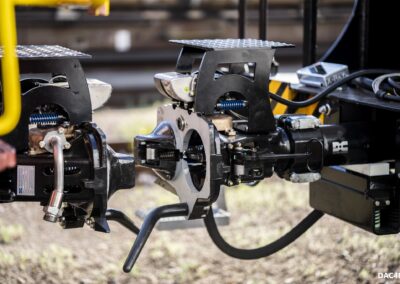
Digital Automatic Coupling (DAK)
At European level, a comparable initiative was taken with the «Digital Automatic Coupling Charter». On 29 June 2020, the final report for the creation of a concept for the migration of a digital automatic coupling system (DAK) for rail freight transport (SGV) was presented. The German Federal Ministry of Transport and Digital Infrastructure (BMVI) commissions and finances the creation of a concept for the migration of a DAK in rail freight transport.
The DAK in rail freight transport is seen as a central element to increase the competitiveness of rail freight transport compared to road freight transport. The biggest challenge in introducing a DAK is to develop and implement a migration strategy that is supported by all. The following key data were used for the study:
- Affected by the migration are: 432’000 to 485’000 existing freight wagons and 17’000 traction units
- Procurement costs of EUR 4’000 to 5’000 for a DAK
- Conversion costs of EUR 2,500 per freight wagon and EUR 5,300 per traction unit
- Procurement and installation of automation components per freight wagon: EUR 5’000
- Total costs of an EU-wide migration, including automation components: EUR 6.4 to 8.6 bn.
- Monetisation of the benefits for the EU-27, incl. Switzerland, Great Britain and Norway: annual benefit potential of approx. EUR 760 million.
- Payback period in the baseline scenario: 18 years
Currently, four coupler manufacturers (CAF, Wabtec, Voith, Dellner) are developing prototypes of a DAK. These will be installed in DB and GATX test wagons and tested throughout Europe by spring 2021. The aim is to agree on the coupler type in 2021 and to start with a migration of the DAK in 2023/2024 at the latest. It is assumed that a migration should take six to eight years and be completed by 2030.
Committed to technical innovation
The VAP has also signed the DAK Charter. It is committed to the rapid and comprehensive automation and digitalisation of rail freight transport as part of the 2017 «Memorandum of Understanding on the Promotion and Implementation of Technical Innovations in Swiss Rail Freight Transport» between the Confederation, VöV and Cargo Forum Switzerland. SBB’s pilot projects, which are made possible and supported within the framework of this agreement, should soon be brought to implementation maturity. In doing so, it is important to avoid half-hearted individual solutions and to trigger a coordinated nationwide automation initiative.